Table of Contents
No, Prometheus didn’t cheat us: reflections on our science of nature
by Christophe Kotanyi
In my youth, I studied natural science with the perfidious intent of finding out what it was really about from the inside. Was it truly the heroic Promethean endeavor to steal fire from the gods for the benefit of mankind? Doubts had already arisen after the total horror of Hiroshima, which served as an exclamation point at the end of the most terrible war human history has known. Hiroshima was the result of the disinterested pioneering work of a handful of selfless scientists who were only interested in piercing nature’s secrets. Their purpose was not to exploit nature, not to misuse her for criminal purposes, not even to make her useful for practical ends. Their purpose was purely scientific—knowledge for the sake of knowledge. Practical uses were of course welcome, but only as a spin-off, as a side benefit. At least, that is how the story is told.
The trouble with our natural science is that it claims to tell us what nature is but in terms of very remote concepts—concepts alien to our experience. Nobody has ever seen atoms, electrons, protons, or molecules; we do not perceive our body as made of little cells that interact, as biology tells us. Nobody has ever tasted vitamins or proteins, and when I have a cold, I do not feel myself being eaten by horrible little animals called viruses—which, to be sure, need not mean that they do not exist. We do not experience water as grains of molecules put together from two elements called hydrogen and oxygen. Water flows, a pure delight. Physics tells us that our weight is the result of a force called gravity, but we do not perceive gravity; we perceive our heaviness. Nobody has ever experienced electricity; what we experience is its effect when we switch on the light or when we touch the wire and get a shock, which we are told is electrical. That is all very puzzling. Science is a very difficult subject.
But it is also very useful, precisely in the Promethean sense, or perhaps more dramatically in the sense of a figure from Biblical mythology called the Golem. The Golem was a divine assistant put at the disposal of humans in a time of extreme emergency. It was made of clay and had the unspeakable divine Name carved on its forehead, making it invincible. However, it was imperative to erase the carving as soon as the emergency was over to prevent the Golem from running amok.
With Hiroshima, our natural science has outed itself as a Golem, which it had been all the time. I have previously argued that the divine Name carved on its forehead takes the shape of the mathematical zero, which is closely related to the mathematical concept of infinity and was earlier a key attribute of the divine.1) I argued there that we must erase it urgently, lest the Golem continue its work of destruction.
In what follows, I would like to discuss three examples of the extreme destructivity of science-as-Golem. These examples are very remote from our everyday experience, but they best illustrate this destructivity precisely because they are both remote and extreme. Yet, these examples are drawn from my practical experience, from my days when I worked as an astronomer engaged in scientific research. Therefore, I now act as a ‘double agent’ reporting from the scientific lab I infiltrated as a common man. But I hope that my former colleagues will not be too cross with me, since I know that they too have been plagued by the same doubts ever since the Pugwash conferences failed to limit the threats of nuclear technology. Since Hiroshima, physics has openly become a central piece of the military industry, of a military now intent much more on the horror of total destruction than on the honors of heroic battle. To avoid being too closely involved in that, I went into astronomy, into the study of infinite spaces out of reach of human misuse. But I soon discovered that I was all too naïve, and the growing militarization of astronomy pushed me out.
Though remote from everyday experience, my three examples are still very well known. We have all heard of black holes, of the Big Bang at the origin of the universe, and of the unsolvable dilemmas of nuclear technology. Every time I out myself as a renegade astrophysicist, people ask me with an eager look in their eyes: What are black holes? What was there before the Big Bang? Black holes and the Big Bang are very mysterious, and they stir up our imagination and quite fundamental issues, even if they seem to be far away from everyday life and at home only in a little world of specialists. If I invite you to cast a suspicious glance at them, it is because I see them as among those rabbits in the scientist’s hat, which are periodically pulled out to trick us into believing the absurdities of science. I think that scientific products should no longer be left to the experts who continue to deceive us, but that should make me a suspicious character too. Double agents always are.
As for nuclear power, it has grown increasingly destructive while growing increasingly indispensable. What are we to do with it? My proposal here is to expose it as a cheat or a fraud, which is made possible because the concepts of science are so far removed from our daily experience that we cannot perceive them as such, as cheats. Following Ivan Illich, who tried to break the spell that abstractions cast on us by showing how they were historically formed, I attempt to do the same by looking at the concepts themselves with an expert but openly critical eye.
The scientific concepts I discuss are puzzling because they are frauds. We say “squaring the circle” to indicate an impossible problem that must be solved by any means, even if the solution is not quite correct. The mysterious power of science can be likened to the way Columbus’ egg can be made to stand on its small end by cracking it, just like mathematics can be made to calculate anything as long as it is founded on the zero, on the absolute nothing at all.
The fraud lies at the inception. Science claims to know the basic elements of the world—atoms, molecules, black holes, the Big Bang, gravity, photons, bacteria, and viruses—that constitute the very substance of nature. We are only capable of experiencing the effects of these scientific entities: weight, light, the colors green and red, the flu, the trees, the butterflies. Congenitally incapable of sensing those basic scientific elements, the common man cannot understand the world according to Science for and by himself.
As a consolation for this grim outlook on science, I will propose to you at the end some examples, again from astronomy, of beautiful and very well-known natural phenomena, even if they are not always present in our everyday lives, which fit very badly in our science of nature and which it therefore simply chooses to ignore.
On Snarks and Boojums
Restons silencieux parmi la paix nocturne
Il n’est pas bon d’aller troubler dans son sommeil
La nature, ce dieu féroce et taciturne.
Let us respect the silence of the night
It is not good to disturb in her sleep
Nature, this goddess fierce and taciturn.
the French poet Paul Verlaine warned (my translation).
The goddess Nature now possesses a new feature invented by science which we may call, with Lewis Carroll, the boojum. This jolly name designates something quite un-jolly, a horrible thing which the astronomers call a black hole, fierce and taciturn, cruel and silent beyond all imagination, so dense that not even light can escape its monstrous grip. Yet it is thought to produce the loudest and biggest things we know of, something puzzling and strange, like Lewis Carroll’s snark, perfectly harmless provided you keep away from it. The astronomers call them quasars. They are also called radio galaxies. These are galaxies that emit radio radiation so intense that if they were close enough, they would jam all our broadcasts like a very huge sonic boom that would silence everything around us. But then we would not be here; we would have been torn to pieces by the black hole. For the snark is a boojum, you see; quasars are black holes. We are fortunately safe; they are very far away, completely benign.
What turns the cruel and silent boojum so loud? That may also be a secret of nature, which we had perhaps better not ask too much about. Nature has taken precautions too. The secret is hidden somewhere between two areas of physics that are incompatible. That is bad news for our science of nature and puts it in very bad shape, which physicists will deny. But that is how our science works. It is very good at cheating.
The snark is a boojum
Let the expression snarks be a nickname for the largest constituents of the universe, at the opposite end to what physics calls the quarks, the smallest constituents. The snarks are the radio galaxies thought to come from black holes buried deep at the centers of galaxies.
These nicknames come from literature. The quark is something bizarre; the term derives from quark, the German word for curd cheese. The boojum is Lewis Carroll’s ominous monster, which we will never know anything about because every attempt will have you vanish softly and suddenly, which very well describes the total horror of black holes. We might apply to them Nietzsche’s aphorism concerning the senile god of a “monotonotheistic” religion turned insane: their only excuse is that they do not exist.
Black holes, just like the so-called cosmic singularity “at the origin of the universe,” the Big Bang, are fantasies of a science of nature turned insane. There isn’t a scientific theory for them, because that would require the use of both the theory of relativity and quantum mechanics, which is impossible since the two theories disagree. Either one is true or the other is true, but not both. To put it simply, quantum mechanics treats forces that have two opposite sides—positive and negative, attraction and repulsion—like electricity and magnetism, whereas relativity theory treats one-sided gravity, only attractive forces. These are mutually incompatible descriptions of the world and cannot be applied to the same phenomena. Albert Einstein was very aware of this incompatibility and rejected quantum mechanics for that reason.
Two theories
A first attempt at their reconciliation was suggested by Stephen Hawking, the author of the best-seller A Brief History of Time, which claimed to help us digest the absurdity of the Big Bang. In terms of relativity theory, black holes must be treated like elementary particles because their enormous gravity makes them indivisible. But then they must obey Werner Heisenberg’s quantum mechanical uncertainty principle, which states that elementary particles will nevertheless divide “to some extent.”2) Some of the enormous mass will escape as energy according to Einstein’s E = mc2, and that will amply explain the intensity of the quasars. Yet a calculation of that energy beyond the “in principle” argument is impossible because the combination of the two theories produces infinite quantities, which physics cannot handle. This rules out the idea as a scientific theory. Astronomers prefer another theory, in which matter forms a thick and hot whirlpool before falling into the black hole, a little bit like the water flowing out of your bathtub, and the snark is produced by complicated electromagnetic forces within the whirlpool. In this case, the calculations indeed provide for nearly but not quite all the energy needed. All the same, the problem is now considered as having been essentially solved, but that is not the case.
Nuclear energy
That is reminiscent of another episode in the history of astronomy and physics, the discovery of the nuclear origin of the energy from the sun and the stars. Two hundred years ago, most astronomers, including the great English astronomer of German origin, William Herschel, were quite happy with the idea of the sun as an enormous mass of coal burning since the beginning of the times. Then the new science of geology pushed that beginning back to a much earlier time, and the idea no longer worked. A new science called thermodynamics was created to explain the sun’s radiation with the transformation into heat of the energy of movement of matter, such as meteors, falling into the sun. Again, that worked nearly well but not quite.
Then came relativity theory and quantum mechanics, which led to the discovery of nuclear energy, which provided a full explanation. That prompted the development of nuclear technology. Yet the sun and our nuclear plants work in exactly opposite ways. The sun puts atoms together to produce energy, whereas our nuclear plants take them apart. The sun produces natural energy; our nuclear plants produce unnatural energy. The nuclear plant is a fraudulent sun. Again, this is a result of the incompatibility of relativity theory and quantum mechanics. In a plain sense, the very intense pull of gravity deep within the sun, necessary to put the atoms together, is even unthinkable on Earth. Physics thinks of gravity and the nuclear forces as if they were separate, but they are not unless we think of the sun as a permanent hydrogen bomb.
When Prometheus stole fire from the gods, was that a fraud? No, that was at least a genuine, honest fire and a genuine, honest theft too, for which Prometheus paid the price. Contrarily, science kills. To steal nature’s secrets, it cuts her into pieces and then itself falls apart into increasingly specialized sciences that are themselves divided into mutually incompatible parts, like physics. And believe me, this incoherence cannot be fixed. Because nature is a deep mystery, and as artist Marcel Duchamp once remarked, all the attempts at piercing her secrets will only make science ridiculous. Maybe we shouldn’t have asked about the sun’s secret in the first place. Maybe we should have just loved it for its beauty.
The cheat
But our science is only interested in usefulness. For that, it produces fictions and calls them nature. Nobody has ever seen atoms, molecules, gravity, electricity, energy, vitamins, proteins, electrons, protons, neutrons, or quarks. Science attempts to square a circle by sleight of hand. For example, it says that the circumference of a circle is equal to the diameter times a number called pi. But pi is not a number; it is a proportion—the ratio of the circumference to the diameter. This may seem like a harmless question of terminology, but it is not. A number has an exact value; three is three and four is four, but nobody knows, and nobody will ever know the exact value of pi. Nature is exact. My hand has five fingers, not one less and not one more. Nobody knows why, and though science promises to explain everything, it cannot, and therein lies the fraud. What science explains is not nature itself, but nature as staged in a lab experiment or a computer model. Nature observed under controlled conditions is nature put on the stage by man. Francis Bacon, one of the founding fathers of experimental science, acknowledged that nature needed to be tortured to reveal her secrets. We know enough now to know that secrets revealed under torture should never be trusted.
The Big Bang
Hawking answers the question “What was there before the Big Bang?” by explaining that, since time was also created then, there can be no “before” the Big Bang. The expression “Big Bang” was created in 1949 by Sir Fred Hoyle, who was against the absurdity of everything beginning in a big explosion, which expresses nothing else than the tendency of our science of nature to produce theories of destruction. Let us skip the question of the absurdity of the very idea of a scientific theory of the entire universe as if the universe could be put into a laboratory. Hawking’s boojum argument ought to apply here too: the universe is indivisible hence it must divide. But if there are many universes, what is the meaning of the word? To put it succinctly, the very idea of a scientific theory of the universe is a fraud, maybe the biggest.
Sun and moon
Did you know that our earth has something astronomically very special, unique among all the planets we know of and perhaps in the whole universe? It is called an exact solar eclipse, which is when the moon perfectly covers the sun in the sky, not a hair’s breadth more or less. For science, that is a meaningless coincidence. But if so, it is an extremely unlikely coincidence, something like an exact copy of you being born elsewhere, and it must happen precisely to our earth—to the only planet with living beings on it we know of in the whole universe. Nobody knows why that is so, but it is very real.
You probably already know that the moon revolves around the earth once in one month, which is exactly the time it takes to spin once about itself. It always shows us the same face, like a stone that you spin around yourself at the end of a string. Science has a perfectly good explanation; let me try to summarize it. The gravity of the earth distorts the moon; these distortions together with the pull from the earth cause the spinning of the moon to slow down, and over many millions and millions of years, it ends up keeping its shape by showing us the same face. That need not be obvious to you, but it works very well mathematically. And now, though you will not believe me because it does not belong to everyday experience, the sun also spins about itself once in the same month. Again, a too-neat coincidence, isn’t it? And believe me, there is again no scientific explanation. Long ago in Western culture, this was called harmony. It is a ridiculous notion today in the time of science, of course. “Harmony” doesn’t explain a thing and is perfectly useless. But harmonies are not there to explain things, to be explained, or to be used. They are there to be admired and wondered at.
As a final example of nature as harmony, our science of astronomy tells us that our eyes cheat us when we see the sun, the moon, and the stars revolve around us. No, that is an optical illusion produced by the earth spinning about itself (which we do not feel thanks to a clever thing called inertia). But have you or anyone else ever seen a movement of the sky that made you wrongly think that the sun, the moon, and the stars were revolving around the earth? No, what we see is that they are now here and then there in the sky, and from that we deduce a movement of the sky, which we never actually see. The very interesting reason for that is that the threshold of sensitivity of our eyes to movement is just sufficiently below that apparent movement so that we always see our sky—the firmament—as perfectly immobile. Why that must be so, I leave it to you, as our dear math teachers would say, as an exercise.3)
A snark, the thinnest foam we know of but also the most saturated with energy. It is ten times bigger than the average galaxy, hundreds of thousands of light years across. This is a face nature shows us when we treat her too badly. Unfortunately, getting just a notion of what you see here would require your initiation too as a research astronomer.
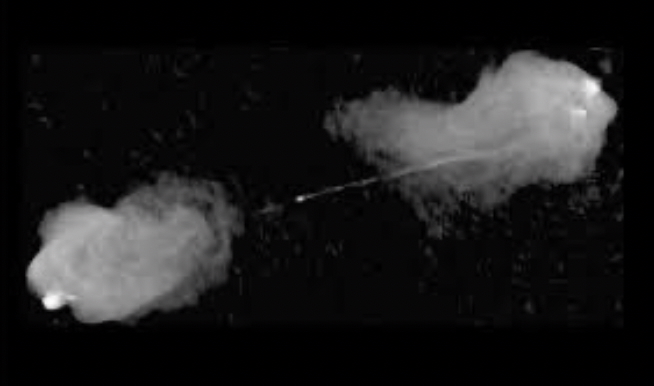
Source: Radio galaxy Cygnus A as seen with the radio telescope of the National Radio Astronomy Observatory, New Mexico, USA.