Table of Contents
Birth and exploitation of common goods in Perugia in the Middle Ages: the case of the "*comunantia fructus water lacus*", of the community of the "Chiugi Perugino" and of the "pedate del lago"
by Giovanni Riganelli
The issues relating to the birth, management, and exploitation of common goods held by rural communities or cities, are remarkably complex. And this is true even if the period of investigation is limited, as in this case, to only the Middle Ages. Giuseppe Vittorio Parigino makes clear that in late medieval Perugia, “communalities” meant “what in modern financial terminology we would call the original or patrimonial income of the municipality.”1) Accordingly, in his work on the economic history of the municipality of Perugia, Giuseppe Mira referred to “income from land and buildings, proceeds from the transfer of fishing rights on inland waters, as well as mint rights.”2) However, as Rino Fruttini shows, in reality, the “communalities” were also of a different kind in the period from 1400 to 1430. In fact, they also concerned the contract for the collection of the toll, that of the tax on wine, on salt and other products, including that relating to the management of the brothel.3) In 1361 when the land register was drawn up, there were 58 communalities in the countryside that had common goods. For the most part, these common goods consisted of land, which covered a total area of 1647 corbe, 1 mina and 23.7 tavole, equal to over 2938 hectares, and buildings, of which there were 16.4)
Having clarified what was meant in Perugia by the term communality, I think it is appropriate at this point to highlight a further, not negligible, aspect: it is the fact that the communalities available to Perugia in normal years – in which no significant events such as wars, famines, and collapse or damage to bridges, roads, and other public works occurred, which were quite rare – managed to cover all the current annual expenses incurred by the Municipality. This, in fact, meant that the city government found itself in the position of not imposing taxes on city residents, according to documents from the beginning of the 13th century.5)
1 – Fishing and hunting at Lake Trasimeno: from *res nullius* to main source of income for the municipality of Perugia
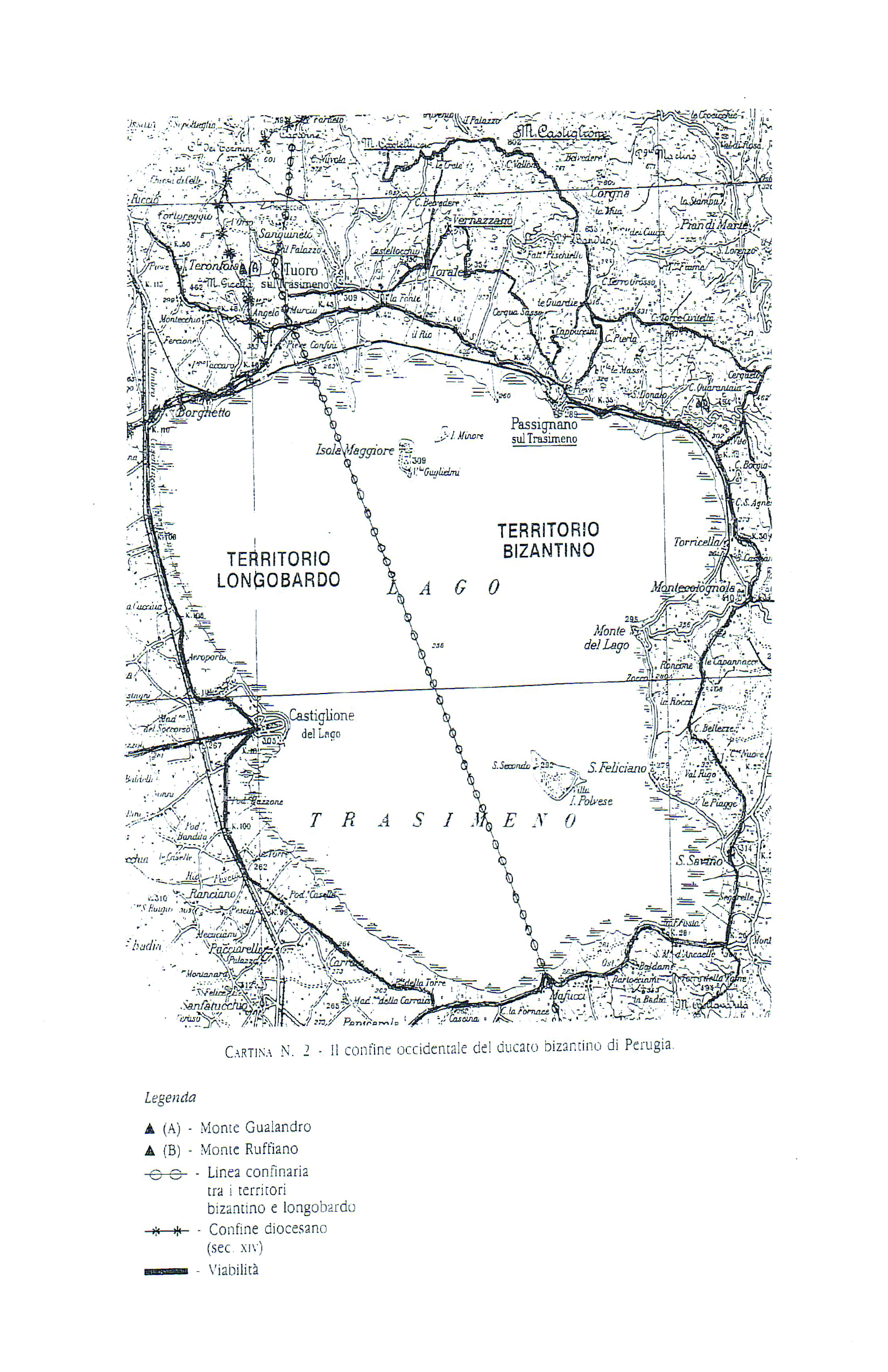
It is therefore now an established fact that except for a few cases, fishing and hunting activities were substantially free in ancient times and in the early Middle Ages. Not only is Lake Trasimeno not an exception but, as attested since ancient times, it seems to have been considerably rich in fish and there must have been many resident and transient water birds that could be caught there. In fact, following what Strabo reports, Lake Trasimeno, which he says is the farthest from Rome and near Arezzo, like the others found in Tuscany, was rich in fish and bird life.6) Even during the Byzantine rule, that is between the second half of the 6th and the second half of the 8th centuries, things did not change. Fish and game continued to be res nullius (nobody’s thing). Moreover, in this period, the lake appeared to be divided in half, with the Byzantines settling on the eastern shore up to and including the three islands –the Polvese, the Maggiore and the Minore –with part of the southern and northern shores, while the Lombards firmly held part of these last two banks and the entire western area. Naturally, there were many fortresses that allowed the defense of these borders and it is enough to mention a few: Castiglione del Lago among the Lombard ones, and Passignano sul Trasimeno and Monte del Lago for the Byzantine ones.7) Beyond this question, it is necessary to underline how starting from the defeat of the Lombards by the Franks in 774, the situation in Trasimeno had to begin to change. For instance, already twenty years earlier, the Church of Rome had to dispose of Perugia, which was granted to it by Pepin the Short. However, on an institutional level, not much seems to have changed. When in 817 Ludovico the Pious reviewed the assets belonging to the Roman Church, the western border of Perugia at Trasimeno, was marked by the three islands. This was also the case in the document with which Otto I on 13 February 962, renewed the same confirmation. But something was moving and soon the lake passed entirely to Perugia and, in 997, it was called Lacus Perusinus.8)
![][image1]
Although the lake had entered the entire territorial jurisdiction of the city of Perugia, things in terms of fishing and hunting did not change much, with the possibility for all the communities around the body of water to freely exercise both activities (fishing and hunting). Moreover, the need to cope with the various days of abstinence from meat that Christianity imposed –between Christmas Eve and Lent for about 130 days a year –must have constituted an important factor for keeping fishing free and, with it, also hunting, given that game (captured or hunted animals) was the main basis of animal proteins in the diet of that time.
Nonetheless, already after the year 1000 there must have been those who saw the fishing activity in Trasimeno as a notable source of income, especially considering the distance of the region (Umbria) from the sea (Tyrrhenian and the Adriatic). Among them, there were probably those who supported the noble coterie which, between the 11th and 12th centuries, had settled in Castiglione del Lago and exercised lordship there. In fact, it is no coincidence that in the act of submission by this castle to Perugia in January 1184, it was prescribed that the practice of fishing would be prohibited to those who resided in this community. To reaffirm its dominion over the lake, the city government not only precluded the Castiglione community from sailing on it, but also forbade it to have ports and boats in the lake, ship buildings, and structures for the operation of fishing (habere aliquod aedificium piscandi cum nave).9) Leaving aside what is strictly connected with the submission of Castiglione del Lago to Perugia, which in fact ended in a definitive and stable manner only in the mid-13th century,10) the ban on fishing in the lake shows how the city, already in that period, intended to take possession of a right that in fact did not belong to it. This appropriation was therefore achieved by force of arms, given that the Castiglione subjugation was one of the few in which a whole series of armed clashes took place. However, the fact is that already in the beginning of the 13th century, in a document dated 5 September 1209, there is mention of a rector of the lake, a certain Bernardo who, in my opinion, would have been nothing more than a person delegated by the city government for the management of Trasimeno, or rather of fishing in it:11) there was therefore already a {administrative} structure dedicated to it.
However, during the first half of the thirteenth century, after long and lively political clashes between nobles and people over the management of the assets that the Municipality had acquired,12) a different way of managing this communality took shape: it would be contracted out to whoever would offer the highest sum to acquire, for a given period of time, all the fishing rights to the waters of Trasimeno, which also included the land located on the shoreline, the so-called pedate del lago “lake steps”, which were later separated and constituted as a communal resource unto itself. The importance attributed to the management of the fishing activity was such that it not only found ample space in the city statute of 1279 and in the vernacular one of 1342 but was also one of the first contracts or tender specifications –in any case the oldest one preserved –included in the volumes relating to the Sommissioni (Submissions), the most prestigious cartulary of the Municipality. Without detailing the individual clauses contained therein, I consider it sufficient to emphasize that those who acquired the aforementioned rights became real lords of the lake and of fishing under the aegis of the city, for the period of ownership.13)
But over time these contracts were also destined to change and, starting from the 14th century, rights to fowling appear with the fishing rights, though the shoreline land was still treated separately.14) The great importance attributed to fishing rights in Trasimeno can be easily understood if we consider that, in the last centuries of the Middle Ages, not only was the city market supplied with fish on the over 130 days a year in which one had to abstain from eating meat, but it was also exported to other cities in central Italy including Firenze, Arezzo, Siena, Città di Castello, Todi, Chiusi and other smaller towns. This allowed those who had acquired fishing rights to also collect the toll for fish exported beyond the borders of the Perugian territory. In short, contractors who had started a company generally ended up earning more than four times what they had paid for the contract.15) What was once free and without constraints had undergone a radical change: not only was the fish now the property of the “state”, but Trasimeno had also become a real hunting reserve. Having documented the transformation of the Trasimeno lake and lakefront from a commons (nobody’s thing) into a property on which fishing and hunting rights were imposed, it is important to highlight how the fountain in Piazza di Perugia – Fontana Maggiore – was largely financed with the proceeds of the contract of this community, although it certainly cannot be ignored that this public good favored the further enrichment of many members of the city’s nobility.16)
2 – The outcome of a violent submission that lasted over time: the expropriation by Perugia of the «Chiugi Perugino» lands and the methods of its exploitation
Between the 11th and 12th centuries, in the territory between the Chiane swamp and Lake Trasimeno, a noble coterie composed of various individuals residing in nearby Cortona and in the lake basin ended up exercising lordship. Most of them had settled in Castiglione del Lago and had managed to acquire, to a large extent, the rights to this castle held by the monastery of San Gennaro di Campoleone, the current Capolona in the province of Arezzo. These rights had been granted by Otto III in 997, then confirmed by Conrad II, in 1026 and 1027, by Henry III, in 1047 and by Frederick I in 1161.17) The submission of the territory west of the lake to the city of Perugia lasted from 1184 until the end of the century and was obtained through the use of force by Perugia, but also fiercely resisted by the Castiglione side. The events that led to this capture marked the birth of a land inheritance for the city of approximately 800 hectares of arable land resulting from the confiscation of assets owned by members of the coterie that ruled Castiglione.18) Even in this case it was not easy for the Perugian government to consolidate this conquest, above all due to the events that followed one another during the first half of the 13th century.19)
Nonetheless, between the spring of 1251and the beginning of the following year, the city government arranged to have all the lands owned by the municipality measured and demarcated. On January 25, 1252, a process began to assign the land to those who would have to work it. This occurred with particular contracts in which the agrarian pact ended up being mixed with the act of personal submission and loyalty to the municipal institution. It was mostly arable land, located largely on the hilly ridge that divides the flat area of Castiglione from that of the Chiane. Alongside these lands, plots were also granted for use as vineyards and vegetable gardens, as well as building areas within the castle of Castiglione. With these concessions, a real nationalization of the territory was achieved which, not accidentally, will be called “Chiugi Perugino” to testify to its ancient belonging to the city of Chiusi and its conquest by Perugia.20) Beyond the issues linked to the name, it is worth highlighting how it was starting from this concession that this large agricultural estate in the city began to be exploited in a systematic way. Such was the economic value of these lands that, during the second half of the 13th century and in the first decades of the following, the company expanded by acquiring more.21) It is therefore easy to understand how for this community, between 1252 and 1279, the methods of land exploitation were established and, as in the case of fishing rights, those of contracting out to private subjects. However, in this case the winner was not the one who offered the greatest sum of money, but the one who offered the greatest quantity of cereals, which would then be crammed into the government's warehouses in the city.22) Like the communality of fishing rights, the procurement of this must also have been a “big deal” and it is certainly no coincidence that, among the contractors, there were prominent figures from the city's aristocracy.23)
There are various rules codified in the city statute of 1279 to regulate the management of the community, but also the entire territory of Chiugi Perugino. Those that are relevant to the management of the municipal company are summarized in three articles concerning the agricultural land including the contracts to procure the common good; the forestry-pastoral activity carried out in the woods and on municipally owned uncultivated land; and the protection of wooded areas.24) Beyond such individual regulations, which would take a long time to list, it is necessary to emphasize the fact that it was an ironclad regulation, aimed at safeguarding the heritage available to the city. Anyone who had infringed these rules incurred considerably high fines and, in the event of insolvency, imprisonment. Through a long and violent submission, marked by destruction and probably even deaths, and the confiscation of assets held by nobles, Perugia expanded its territory. An agricultural estate was thereby born which allowed it to have sizable quantities of wheat, barley, and spelt annually, with which to cope, at least in part, during the lean years.
3 – The "steps of the lake": the birth of the community and the relationships between contractors and growers of the same
Another agricultural community present around the lake basin was that of the “lake treads” or shoreline lands to which reference has already been made. This was related to the shoreline terrain and indicated that relatively large, marshy area with intense vegetation and without trees. These lands, or at least part of them, were the result of a confiscation from the so-called Lacosciani, meaning those who lived around Lake Trasimeno were called, during the events that marked the submission of Castiglione del Lago at the end of the 12th century. They were located in the area of San Savino, in the area between Tuoro and Passignano di Tuoro as well as near Monte Gualandro and, until the end of the 1380s, they were contracted out together with the community of fishing rights, although there were exceptions. These lands are recorded in the minutes of the city council of 10 July 1269, a period in which they had been contracted separately from the other given that in late spring or early summer when the buyers of the fruit obtained from the treads of the lake owned by the Municipality of Perugia (emptores fructuum pedatarum lacus comunis Perusii) presented a petition to the city government. It was pointed out therein that the shoreline lands had been occupied by those who had properties bordering them, while some parts no longer had the boundaries between the municipal lands and those of private individuals as they had been removed. A further attempt to make these lands a separate community occurred at the beginning of the 1280s, when the fishing rights were contracted out separately from those for the lake treads. But even in this case the limited proceeds that were to be derived from the contract by the city municipality had to determine their reunion in the second half of that decade. But the time was ripe for a definitive separation which probably took place during the last part of the 13th century or in the very first years of the following one, when Trasimeno was also made into a hunting reserve, with the period of this transformation to be ascribed to that between 1290 and 1302.25)
The terms of this common good was not comparable to that of the fishing rights and that of the Chiugi Perugino. On 10 December 1311, it was contracted out for a decade, starting from 1 May of the following year, for a total of 7,000 lire of small Cortonese denarii. The sum, in the ten-year contract stipulated in 1321, increased and the community was sold for 10,000 lire of denarii. Beyond the price paid by the contractors to win it, I think it is important to see in detail what the contractor ended up acquiring with the rights relating to these lands. He and his partners could take the lands away from those who worked them and assign them to others and those who worked them had to give them what was due to the city, generally a third of the fruits. As noted in the same contract, the contractor and his partners held this property in lieu of the city government and were given the ability to act as if it were their property. The city would not have harmed the rights of the contractors in any way and, if it had done so, it would have taken steps to resolve any dispute, also specifying that the assets granted were free from any restrictions and were not occupied by anyone. The contractors, during the stipulated period would be defended by every man and every community at the expense of the city government.26)
Among the clauses contained in the contract there is the possibility for the contractors to take away the lands from those who worked on them to rent them to others which seem to be in contradiction with what is contained in the city statute of 1279. In it, Article 234 specifies how the fruits of the water and of the treads of the lake, together with the land of the islands, had to be sold (Qualiter fructus aque Lacus et pedatarum vendantur cum terreno insularum). It is written therein that the men of the lake had to take care of the cultivation of the treads without malice, as had been customary (de Lacu sine malitia, sicut est hactenus consuetum).
The buyers of the shoreline lands of the lake (emptores pedatarum Lacus) could however lease the hard and uncultivated lands of the same lakeshore lands to others whenever they wanted and receive from the lessees what they had agreed upon.27) In the space of thirty years or so there was an evolution in the management of this community, conferring greater power on those who acquired the rights to exploit it. Being able to rent land at will is, in my opinion, a way to put pressure on farmers under the threat of exclusion from cultivating the land. But the exercise of this “power” regarding the sharing of the lakeshore land from which the owners benefited until well into the twentieth century, had a short life due to the disappearance of this common good during the fourteenth century. The “steps of the lake” were, in fact, no longer present as a city heritage since 1400, at least according to what was reported by Fruttini.28)