Ivan Illich, Tools for Conviviality (New York: Harper & Row, 1973). All page references in the text are to this volume.
A full analysis of this book would have to incorporate comparisons with at least three basic translations, which have benefitted from Illich’s revisions.With commentaries quoted from hand written notes by the author (dated April 1987) on the title pages in a special collection of the Rare Books Room at the PatteeLibrary of the Pennsylvania State University, these are:
La convivencialidad (Barcelona: Barra!, 1973). Pp. 148. Translated from En-glish by Matera Padilla de Gossmann, but “totally reviewed by the author if notdictated to Doña Matera.” Numerous additions and subtractions. For
example, the first two paragraphs of the English introduction are enlarged to three paragraphs in Spanish, while the section on tools and libertarian jus-tice (adapting John Stuart Mill) at the end of chapter two is simply deleted.
La convivialite (Paris: Seuil, 1973). Pp. 160. From the title page of the English edition of Tools for Conviviality: “N.B. A posterior, French book, based on this hasbeen totally re-written by me, and has often served as the basis for trans-lations into other languages.”
Selbstbegrenzung: Eine politische Kritik der Technik. “Tools for Conviviality.” Reinbek bei Hamburg: Rowohlt, 1975. Pp. 190. German by Thomas Lindquist. Copyright references to both English and French versions. “This is the final version of my essay, which goes beyond the French. I wrote it with the assis-tance of Dr. Gustav Kiinstler, my teacher, mentor and paternal friend, while he was immobilized dying in a Vienna hospital.”
Table of Contents
Tools for Conviviality: Argument, Insight, Influence*
by Carl Mitcham
(*) Paul T. Durbin (ed.), Europe, America, and Technology: Philosophical Perspectives, 17-56. © 1991 Kluwer Academic Publishers. Printed in the Netherlands.
Ivan Illich is the author of more than ten books during the last twenty years published in over a dozen languages. In their diversity these works can appear to defy thematic unity. Their focus seems variously to be pastoral theology, educa-tion, development policy, medicine, economics, urban plan-ning, gender, literacy. What follows is an exercise in taking one of these books, Tools for Conviviality, as central to the Il-lich corpus as capable of benefiting from a detailed interpre-tive analysis.1)
The rationale for focusing on Tools for Conviviality can be articulated as follows: Illich’s first books which are not simply collections of previously published essays are Deschooling Society (1971), Tools for Conviviality (1973), Energy and Equity (1974), and Medical Nemesis (1976). The next monograph does not appear until six years later, with the publication of Gender (1982). The initial four monographs thus constitute a kind of founding set, circumscribed by time. It is also the case that among these books the first, third, and fourth are case studies of particular prob-lems - that is, schools, transportation, and medicine - with the third being more an extended essay than a monograph.2) Only the second, Tools for Conviviality, is a general anal-ysis. It is, moreover, a volume that refers back to preced-ing work and anticipates work still to come. It is the book to which Illich makes the most explicit references in later work.3) Its centrality is not only temporal but substantial, thus calling for extended consideration of its argument.
1. Argument
The argument of any text is situated within an exposi-tory structure. Tools for Conviviality is composed of fivechap-ters. The central and longest is chapter 3, “The Multiple Bal-ance.” This is, however, divided into six numbered and named sections. The largest undivided section in the text is chapter 2, “Convivial Reconstruction.” Chapter 2consists of thirty-six pages, chapter 3 of thirty-eight. No other chapter is more than sixteen pages in length. A cursory inspection of the overt fea-tures of the book thus suggests that these two chapters consi-tute, in different ways, complementary centers.
Exactly how the center is a center is, however, prepared by a beginning. Preceding the first chapter are sections entitled “Acknowledgments” and “Introduction.” The acknowledgments are extensive and mention byname over fifty persons from countries in Europe and North, Central, and South America. The Center for Intercultural Documentation (CIDOC) is also explicitly credited. It is clear from the acknowledgments that this is to some extent a cooperative text or a text that grows out of cooperative effort.
The introduction begins by defining this cooperative text as part of a larger work-in-progress, “an epilogue to the industrial age” (p. xxi). Illich says that he wants “to trace the changes in language, myth, ritual and law which took place in the current epoch” (p. xxi). Illich thus identifies his work with the owl of Minerva taking wing at the end of the day. But Illich also immediately declares that he wants “to show that two thirds of mankind still can avoid passing through the industrial age, by choosing right now a post-industrial bal-ance in their mode of production which the hyperindustrial nations will be forced to adopt as an alternative to chaos” (p. xxi). Not only isIllich looking back with the owl of Minerva, he is looking forward with the cock of Athena.
The introduction further mentions how this book is part of a publishing series entitled “World Perspectives” ed-ited by Ruth Nanda Anshen. Deschooling Society was in the same series.4) To emphasize the connection, Illich summarizes three conclusions of CIDOC research that are presented in that previous text. But, he suggests, the conclusions of De-schooling Society can be generalized - which is thus evidently the function of the present effort.
The most general conception to be found in Deschool-ing Society is a distinction between what are termed “right manipulative” and “left convivial” institutions. This distinc-tion, which is developed in the central chapter of his first monograph, provides the title of the second monograph.
As an initial cut at the basic generalization of the pres-ent text, however, Illich puts forth the thesis that industrial growth in both goods and services can, up to a certain level, be beneficial, although afterward further expansion readily becomes detrimental. This foreshadows the explicit argument of the first chapter, a case study of how medicine illustrates these two turning points. His basic interest, however, is “a general theory of industrialization” (p. xxiii) that would as-sess the relation between human beings and tools in a mul-tidimensionalframework. This, it will turn out, foreshadows the concerns of chapters 2 and 3, the already suggested central chapters.
At the end of the introduction Illich offers a comment on his title and use of the term “convivial” or“conviviality.” In an italicized sentence he writes that “a society, in which modern technologies serve politically interrelated individuals rather than managers,[he will] call convivial” (p.xxiv). He admits this is a potentially misleading term, but chooses it as a chal-lenge to thought, and associates it with self-limiting discipline and austerity in the classical sense of Aristotle and Aquinas. As he says, “Austerity is a virtue which does not exclude enjoyments but only those which are destructive of personal relatedness” (p. xxv). Conviviality names that disciplined be-ing-with-others expressed through serious but playful enjoyment.
Some self-limitation is necessary for living with (Latin con + vivo) others, for friendship and its playful engagements. Austerity is that virtue which is necessary to delimit or restrict irrelevant elements and distractions that can undermine the play which is constitutive of and makes possible pleasurable being together with others. The sexual connotation of the word “tool” - and the need for active but sparing use of the male organ if “conviviality” is to be maintained - is not unre-lated to Illich's fundamental argument. It will be further sug-gested that tools for conviviality must be tools of conviviality; conviviality cannot be accidentally superimposed on just any tools by the intentions of users or agents. Finally, conviviality has implications not only for living with other persons, but also(and even) for living with other tools. Some tools inhibit not only certain human relationships but also relationships with other kinds of tools. Otherness in Illich's context includes more than persons.
At this point Illich introduces one of only two foot-notes in his text, a reference to Hugo Rahner's Man at Play. (Hugo is the brother of the influential Catholic theologian Karl Rabner.)
The first chapter, “Two Watersheds,” uses the example of medicine, an example that will be developed at muchgreat-er length and with copious footnotes in Illich's subsequent book, Medical Nemesis. The “two watersheds” argument can be stated succinctly as follows. The first “watershed” or thresh-old in medicine occurred around 1913, when a diseased patient began to have a better than even chance that a profes-sional physician would be able to provide effective treatment. The second threshold occurred during the mid-1950s, when modem professionalized medicine began to cause as well as cure disease.
The rise of iatrogenic illness to prominence in medi-cal care creates a new kind of medicine. From this point on medicine will spend increasing time dealing with problems it causes - from staph infections caused by residence in hospi-tals, and bacilli which have become immune to sulfa drugs or first-generation antibiotics, to the mistakes or complications of surgery and debilitating therapies. Indeed, it is possible that more than fifty percent of the effort in modern medicine is now devoted to dealing with problems or illnesses that would not exist if modem medicine itself did not exist. Certainly, the problem of testing and evaluating medical procedures (both pharmacological and technological) has become an increasing concern of the medical community.5)
At the conclusion of chapter 1, Illich states that the two watersheds phenomenon is not limited to high-techmed-icine, but inherent and manifest in many branches of modem technology. Moreover, “development” beyond the second threshold depends on a combination of ideological inertia with conceptual transformations that are typical of social institutions. Insistence that, since previous technical change has been beneficial, further technical change should be too, is reinforced by subtle re-definitions of goals in technical terms dependent on professional expertise.
At first new knowledge is applied to the solution of a clearly stated problem and scientific measuring sticks are applied to account for the new efficiency. But at a second point the progress demonstrated in a previous achieve-mentis used as a rationale for the exploitation of society as a whole in the service of a value which is determined and constantly revised by an element of society, by one of its self-certifying professional elites (p. 7).
It is technical imperatives of professionalized medicine, not the health care needs of the general public, that have, since the mid-1950s, driven the course of medical change through coronary bypass operations and hysterectomies, computer-ized tomography, nuclear magnetic resonance, and positron emission tomography scanners, organ transplants, artificial hearts and so on. It is professional scientists and engineers who argued in the late 1940s for establishment of the National Science Foundation as a means for the governmental support of science and technology independent of military or political supervision - for the good of society, of course. It is similar self-certifying professional elites who defend the Human Ge-nome Project and the superconducting supercollider.
This first chapter sets the stage for the general issue to be addressed by the remainder of the book: how to avoid or respond to the second threshold, after which technology begins to be less unambiguously effective in meeting basic human needs. The simple answer is that somehow technological development must be limited or altered in its direction.The “more” ideology - more technology, more science, more political management, even more information and interdisciplinary research -is not the solution.
Any attempt to alter a social or technological process will include one or both of two elements: the carrot and the stick. Chapter 2, “Convivial Reconstruction,” is (as it were) the carrot of imaginative alternative possibilities.Chapter 3, “The Multiple Balance,” presents the stick of crisis or necessity that will force us to actualize these possibilities. Chapters 2 and 3 thus provide a kind of systole and diastole of Illich's argument.
This systole-diastole character of the argument is repeated in foreshortened form by chapters 4, “Recovery,” and 5, “Political Inversion.” The former articulates the ideals behind three obstacles to the development of a politics of tools; the lat-ter, how these obstacles can be overcome or how a politics of tools might be forced upon us. Following an introduction into the heart of Illich's argument, there is a kind of four-chambered beat that takes us through it, and then places us back in the body of our own lives.
The first beat of this four-chambered heart is chapter 2. As the first, it is also, and in this sense, the most important; it sets the rhythm for all that follows.
Chapter 2, with two untitled breaks in its text, can be divided into seven sections. The first three sections fill sixteen pages and are punctuated by a break; the next three sections again fill sixteen pages, punctuated by a second break; the last section covers four pages.
In the first or introductory section of four pages, it is emphasized that the essence of what is needed is a newconcep-tion or understanding of tools and, indeed, new kinds of tools. It is this new understanding or perspective on tools, and the attempt to identify the new kinds of tools to which this under-standing leads, which is the theme of chapter 2 - and, indeed, of the book.
The key issue for Illich is that people “need new tools to work with rather than new tools that 'work' for them” (p. 10). The distinctive character of modern technology is its tendency to become progressively independent of sustained hu-man engagement. “People need not only to obtain things, they need above all the freedom to make things among which they can live, to give shape to them according to their own taste and to put them to use in caring for and about others” (p. 11). To procure for themselves these new kinds of tools, there must be developed a new politics. This new politics of tools
would aim principally to exclude the design of artifacts ... that are obstacles to the exercise of .. . personal freedom. Such politics would limit the scope of tools as demand-ed by the protection of three values: survival, justice, and self-defined work (p. 13).
Illich notes, in passing, that these ideals may well be violated temporarily in any historical transition from the present pol-itics of tools which promotes the expansive and virtually un-limited development of what might be termed autonomous tools to a more austere conviviality of engagement tools.
In a second four-page section Illich itemizes six issues he will not address in the discussion that follows. He will (1) not provide utopian solutions, (2) nor a manual for action, (3) nor focus on the character of users. He will (4) not sketch political tactics or strategies, (5) nor detail the applications of distributive and participatory justice. He (6) admits that a convivial society will include some inequality, and that mo-dem convivial tools “would be incomparably more efficient than primitive and more widely distributed than industrial [machines]” (p. 17). Illich is not an egalitarian democrat, but neither is he the proponent of a romantic return to preindus-trial life simply construed.
Having specified what the focus is not, Illich under-takes a transition to his primary theme, which he calls the specification of “negative design criteria for technological devices” (p. 18). Although it is such criteria that must ground any politics of the limitation - or any politically implemented delimiting - of tools, this is not, he warns, a thesis which is easy to broach or appreciate. Industrialized disengagement from tools, not to mention the promotion by educational institutions of the political ideology of the expansion of autonomous tools, clouds the common mind. There are implicit references, once again, to Deschooling Society.
With this transitional warning Illich turns in the third section to the crucial argument of his text. (This third section of six pages constitutes the most sustained and concentrated passage in the whole book.) Illich begins by defining a tool “broadly enough to include not only simple hardware such as drills, pots, syringes, brooms, building elements, or motors, [along with] large machines like cars or power stations, [but also] productive institutions such as factories…and produc-tive systems for intangible commodities such as those which produce 'education,' 'health,' 'knowledge,' or 'decisions'” (p. 20). His concept of tool subsumes “into one category all ratio-nally designed devices, be they artifacts or rules, codes or op-erators, and [distinguishes] all these planned and engineered instrumentalities from [thosewhich] in any given culture are not deemed to be subject to rationalization” (pp. 20-21). A tool is any explicitly articulated rational structure, whether material or cultural.
Among this broad spectrum of tools, what kinds satisfy the criterion of conviviality? The common idea is that tools in this broad sense are able to be used to promote conviviality or non-conviviality - or any other ends - depending on end-user intentions and the social processes within which they function. The issue is primarily one of intention or use, individual or communal.
But according to what Illich has already said, his “subject is tools and not intentions” (p. 14). He wants to“focus on the structure of tools, not on the character structure of their users” (p. 15). Although it is true that “an individual relates himself in action to his society through the use of tools that he actively masters,” it is also the case that “he is passively acted upon” by his tools and that “the shape of the tool [can deter-mine] his own self-image” (p. 21).
The use of industrial tools \[for instance\] stamps in an iden-tical way the landscape of cities. . .. Highways, hospital wards, classrooms, office buildings, apartments, and stores look everywhere the same. Identical tools also promote the development of the same character types. Policemen in pa-trol cars or accountants at computers look and act alike all over the world, while their poor cousins using nightstick or pen are different from region to region (p. 15).
Two points are to be noted here. One is that technologies make or transform users as much as makers or users trans-form technologies or the world. The other is that some tech-nologies (namely, modem technologies) homogenize their world and their users, whereas others (traditional technolo-gies) leave natural diversities intact.This means that “the progressive homogenization of personalities and personal rela-tionships cannot be stemmed without a retooling of society” (p. 15). “Convivial tools are those which give each person who uses them the greatest opportunity to enrich the environment with the fruits of his or her vision” (p. 21).
To consider this principle more clearly in relation to the structure of tools, Illich begins by distinguishing hand tools from power tools. The hand tool uses human metabolic energy, the human sensory organs, and the human mind in order to perform specific tasks which are not strongly determined in advance. The hammer, for example, depends on muscular energy from the arm and the sensorimotor intelli-gence of internal balance, proprioception, and hand-eye co-ordination to perform a diversity of tasks: nailing and pulling nails in timber, planks, drywall, shingles, etc., while constructing houses, barns, crates, or furniture.
By contrast, the power tool uses non-human energy, that is, is moved more or less by energy from outside the human body: from domesticated animals, wind or water, heat and steam, internal combustion engines, or electricity. Hu-man engagement with an externally powered tool tends to be limited to hand-eye coordination for the performance of increasingly predetermined and specialized functions. There is one kind of nail gun for drywall,another for shingles, with neither being interchangeable or usable for fastening timber or planking.
As the power tool is transformed into the machine, the human being becomes not so much the user as an operator or monitor. Already with draft animals attached to plows, for instance, users have to do more watching of what is going on than if they were hoeing or raking, but they still have to take care of living “energy sources” which also require guidance operating through multiple sensorimotor engagements (sensorimotor coordination of hand-eye, eye-sound, sound-hand and feet, body shifts, etc.). In the long multi-phased trajectory from horse-drawn plow to airplane, human guidance is made increasingly de-incarnated, dependent more and more on eye interpretation of analogical and digital gauges, and thus progressively dependent on technical or professional training.
Tools foster conviviality to the extent to which they can be easily used, by anybody, as often or as seldom as desired, for the accomplishment of a purpose chosen by the user. The use of such tools by one person does not restrain another from using them equally. They do not require previous certification of the users (p. 22).
Although hand tools much more readily than machines lend themselves to convivial use, “the distinction betweenconviv-ial and manipulatory tools is independent of the level of tech-nology of the tool” (p. 22). The telephone system, for instance, is an electronic tool for conviviality - indeed, it is an insti-tutional tool for conviviality. But as an originally convivial institution “moves toward its second watershed [it] tends to become highly manipulative” (p. 23), that is, to require specialized knowledge or professional certification, to impose its own “intentions” (as it were), to be useable only at a cost to someone else. As the system for electronic communication moves from telephone to radio to television, access to active usability is replaced by passive consumption and manipula-tive programming under the direction of professional elites.
Nevertheless, “it is a mistake to believe that all large tools and all centralized production would have to be excluded from a convivial society” (p. 23). “The criteria of convivial-ity are to be considered as guidelines to the continuous process by which a society's members define their liberty” (p. 24). There are no purely manipulative or convivial societies. The crucial issue for citizens living within technological society is to consider the balance between convivial and manipulative tools, to admit the existence of the latter, and to strive to foster and protect them. Not only is Illich no preindustrial roman-tic, he is also no purist.
Although Illich does not make the historical refer-ence, his inspiration derives from the same insight as that of the early 19th century Luddites, and he carries on a running argument with the inadequacies of counter Luddite or socialist commitments. Socialists and Marxists of all varieties ignore “the one issue that counts: careful analysis of the basic structure of tools” (p. 25) and emphasize instead transforma-tions in the structure of ownership. The real issue
is not the juridical ownership of tools, but rather the dis-covery of the characteristics of some tools which make it impossible for anybody to "own" them. The concept of ownership cannot be applied to a tool that cannot be con-trolled. The issue ... is what tools can be controlled in the public interest. Certain tools are destructive no matter who owns them, whether it be the Mafia, stockholders, a foreign company, the state, or even a workers' commune (pp. 22-26).
At this point Illich catches his breath and punctuates his argu-ment with a break in the text.
When Illich resumes his discourse, he does so with a four-page analysis of the relation between energy input and the equitable or just distribution and use of tools. In pre-modern or hand tool-dependent societies, “to control more power than others [a person] had to lord it over [others]” (p.28). Human energy expended in the act of guidance is not only progressively dwarfed by the energy expended through the machine itself, but coordinate with the creation of power tools utilizing non-human sources of energy there is intro-duced into the social fabric a radical inequality of energy ac-cess. The argument of this section, as repeated and elaborated at other points in the text (e.g., in chapter 3, sections 4 and 6), is rephrased as the extended essay, Energy and Equity.
There follows a five-page consideration of ancient and modern conceptions of work. A sixth section provides seven pages of examples of convivial reconstruction in medicine, in transportation, and in housing.
Following a second break, a four-page reprise on jus-tice and tools concludes the argument. Illich states, in words reminiscent of John Stuart Mill, that “a just society [is] one in which liberty for one person is constrained only by the demands created by equal liberty for another” (p. 41).6) Some tools or arrangements of tools have an inherent tendency to interfere with or to restrict the liberty of choice and action of persons in their midst. It is just as illegitimate to construct or to maintain such tools as it is personally to constrain the choices and actions of another. This theory of justice, which takes personal liberty as its foundational good, when applied to technology demands the principled limitation of “tools that by their very nature prevent such liberty” (p. 41). “The prin-cipal source of injustice in our epoch is political approval for the existence of tools that by their very nature restrict to a very few the liberty to use them in an autonomous way” (p. 43).
What is required is especially a criticism of power tools, since these have an inherent tendency toward central-ized control and specialization that allows “neither the worker nor most engineers a choice over what use will be made of the energy they manage” (p. 42).
The public ownership of resources and of the means of production, and public control over the market and over net transfers of power, must be complemented by a public determination of the tolerable basic structure of modem tools. This means that politics in a postindustrial society must be mainly concerned with the development of design criteria for tools rather than as now with the choice of production goals (p. 43).
At the same time, the inversion of the politics of tools that would result must be shown to be, not just ideal, but alsonec-essary. Ought implies not only can, but demand. “To translate the theoretical possibility of a postindustrial convivial lifestyle into a political program for new tools, it must be shown that the prevailing fundamental structure of our present tools menaces the survival of mankind” (p. 45). The carrot is to be complemented by the stick.
Chapter 3, “The Multiple Balance,” argues the dynam-ic instability of the industrial or power-tool-dependent soci-ety across five distinct dimensions and a sixth dimension of their multiple interrelationships. In response to each of these, Illich seeks to recover three principles of moral, political, and juridical procedure that underlie his critique of tools: the legitimacy of agonistic discussion, the rightful influence of his-tory or tradition, and the primacy of non-professionals “for binding policy decisions” (p. 48).
With regard to the environment, pollution deprives humanity of “the right to the fundamental physical structure” of the biological world (p. 47). Human beings have “evolved to fit into one niche in the universe,” and theEarth as their home “is now threatened” (p. 49). This threat points not only toward “the need to limit procreation, consumption, and waste [but equally to the need to] radically reduce our expectations that machines will do our work for us” (pp. 49-50). We must reject “the false expectation that somehow human action can be engineered to fit into the requirements of the world conceived as a technological totality” (p. 50).
Already in the early 1970s, Illich identifies the danger of overemphasizing the issue of ecology. He specifically criticizes Paul Ehrlich (to whom is attributed the only undocu-mented quotation in the text, a quotation that he immediately makes his own), and Barry Commoner, and raises the prob-lem of what a colleague will later term “the gospel of global efficiency.”7) Illich, in a deft quotation from Herbert Marcuse regarding “the materialization of values” or the instantiating of values in technical programs, at once points out an essential issue sometimes obscured by new left neo-Marxist jargon and distances himself from that jargon.(To Marcuse's One-Di-mensional Man Illich accords his second footnote.)
With regard to work, the challenge is what Illich calls “radical monopolies.” Radical monopoly results from “the dominance of one type of product rather than one brand” (p. 52), a domination which occurs “when people give up their native ability to do what they can do for themselves and for each other, in exchange for something 'better' that can be done for them only by a major tool” (p. 54). Cars - not just cars made by some one company - radically monopolize ur-ban transit (excluding bicycles, horses, etc.). Schools radically monopolize education (excluding self-education, tutoring, mentoring, apprenticeship, etc.). Physicians radically monop-olize medical care (excluding chiropractors, homeopathists, osteopaths, etc. - not to mention self, parents, and children). Neither consumer protection laws nor socialism is an ade-quate response to radical monopolies.
With regard to education, Illich notes the increasing costs of education but rejects two common rationalizations for this situation: education as a means to some social end (greater productivity), and as an output in itself (post-indus-trial society theory). Education is increasingly expensive because the increasing social density of nonconvivial tools necessitates it, and because education using nonconvivial tools is economically unfeasible. The more high-tech the tool, the more its use is dependent on training manual instructions or professional trainers. But even when we learn “how to operate the TV or the telephone…their workings are hidden” from us (p. 59). By contrast, from personal trial-and-error engage-ment it is possible to learn not only how to use a convivial tool, but how it works. What are today called “user-friendly interfaces” in no way address the disparity Illich identifies. (lllich's remarks on the convivial character of the alphabet and books anticipate points reiterated later in greater detail in ABC: The Alphabetization of the Popular Mind.)8)
Because of the separation of teaching about how to work things from learning about how things work, modern education is incapable of bringing about the kind of radical transformation of behavior required by the present multi-di-mensional crisis. Although it is true that “people must learn to live within bounds,” this learning“cannot be taught” (p. 65). “A new practice … can only be the result of a new relation between people and their tools” (p. 66).
With regard to politics, there exists an increasing, technologically mediated concentration of power.
As tools get bigger, the number of potential operators declines. There are always fewer operators of cranes than of wheelbarrows…Never before have tools approached present power \[and\] been so integrated at the service of a small elite (p. 70).
With regard to culture, technical obsolescence and recurring technical change threaten tradition. When artifacts are manufactured by complex, single-product, expensive machines and machine systems, the gradual, incremental wearing out of products (which will be replaced one at a time) cannot support technical change. What is needed instead is the sud-den rejection and replacement of large numbers of artifacts. Obsolescence, whether by advertised fashion, economic redundancy, or technical pressure is a necessary feature of the nonconvivial tool-dependent social order. Culture is trans-formed from a vehicle of tradition and preservation into a means for enforcing change.
Reviewing the five basic imbalances, Illich maintains that these must not be taken as independent variables. They are intimately interrelated and must be counteracted together. This is indicated by personal frustrations in response to the logic by which persons are regularly constrained to choose ends because they fit tools rather than tools because they fit ends. Given such a situation, one either learns to abstain or goes mad.
To promote the first option, and the re-creation of appropriate or convivial tools, Illich calls for the development of what he terms “counterfoil research” that will “provide guide-lines for detecting the incipient stages of murderous logic in tools [and] devise tools and tool systems that optimize the balance of life, thereby maximizing liberty for all” (p. 77). The basic principle is that, “Tools … have an optimal, a tolerable, and a negative range” of application (p. 78), which need to be clearly identified, through empirical as well as conceptual investigation.
Just as he is neither romantic nor purist, so is Illich no rationalist. The conceptual clarifications of his text are regularly complemented by empirical information and by arguments from experience. The nonacademic character of the text is nowhere more obvious than in the absence of bibliog-raphy and references. Illich does not just call for the initiation of counterfoil research, he does it.
Turning again, then, to the carrot, chapter 4, “Recov-ery,” outlines a functioning politics of tools. Tools both extend and eliminate human capabilities.9) A politics of tools depends on public recognition of the elimination possibility, “establishing procedures which permit ordinary people” to exclude “the malignant tool and control the expedient” one (p. 85). The obstacles to such recognition and practice are the idola-try of science, debasements of commonlanguage, and loss of respect for traditional processes of social decision making. In initiating a demythologization of science, a recovery of lan-guage, and a defense of legal procedure, Illich directly reaf-firms three principles that were only indirectly elucidated in chapter 3 - i.e., agonistic discussion, tradition, and non-pro-fessional authority.
Scientism and technocracy are based on mistaken ideas about knowledge and information as realities indepen-dent of human interpretation. The corruption of language likewise turns human actions into substances to be possessed. “To work” and “to learn” become “jobs” and “education”; actions that were part of living become things to have. By virtue of both scientism and the corruption of language
Limiting tools for the sake of freedom and conviviality is
… an issue that cannot be raised To recommend limits
on tools sounds as deeply obscene today as the recom-mendation for greater sexual frankness and freedom as a condition for a good marriage law would have sounded a generation ago (p. 91).
Promotion of an authentic politics of tools depends on the use of language as “a second-order tool” to clarify issues (p. 91) and law “as a tool for the inversion of society” (p. 93).
Formal adversary procedure is the paradigmatic tool for citizens to oppose the threat of industry to their basic lib-erties. Like ordinary English, formal process is a convivial tool (p. 97).
Before it became common practice among the anti-nuclear and environmental movements, Illich was advocating the activist utilization of legal procedure to protest and alter the course of technological change.
Finally, in chapter 5, “Political Inversion,” Illich returns again to necessities. The political inversion that constitutes a true politics of tools will rest on a new consensus growing out of a convergence of “enlightened self-interest,” not “shared ideologies” (p. 102). The formation of such a new majority can be stimulated by crisis situations. A crisis has “the potential of turning public imagination inside out” (p. 103). “That people would accept multiple limits to growth without catastrophe seems highly improbable” (p. 105). But “the transformation of catastrophe into crisis depends on the confidence an emerging group of clear-thinking and feeling people can inspire in their peers” (p. 106).
The only response to this crisis is a full recognition of its depth and an acceptance of inevitable self-limitation. The more varied the perspectives from which this insight is shared by interest groups and the more disparate the in-terestthat may be protected only by a reduction of power within society, the greater the probability that the inevi-table will be recognized as such (p. l 07).
In the end, political inversion will come about not just on the basis of an attractive ideal but because of a kick from history. Yet for the kick to bring about anything more than meaning-less pain, there must be insight into old needs and new possibilities.
The argument of Tools for Conviviality can thus be summarized as follows:
Chapter 1 Modern tools exhibit two levels of utilization; initially subordinate to human ends, they eventually take on a self-serving character. Chapter 2 The inner structure of modem tools that grounds the second level of utilization is, first, the mechanical adaptation of non-human sources of energy and, second, the creation of coordinate technical means. Chapter 3 At the second level of utilization there emerge at least five distinct imbalances in environment, work, meaning, freedom, and culture. Chapter 4 Recovery of balances across these five dimen-sions and their interrelations requires the development of a politics of tools based on demythologized science, non-technical language, and legal procedures. Chapter 5 This inversion of politics can be fully realized only if catastrophe turns to crisis through insight.
2. Insight
Against the background of this interpretive overview of the argument, it is appropriate to venture a thematic appreciation of the text. Such a thematic appreciation can also provide a basis for considering further relations to the Illich corpus and to larger traditions of philosophical reflection on technology.
Tools for Conviviality grows out of a recognition of the fundamental importance of insight. This insight into insight (as it were) is the formal foundation of the work, with both theoretical and practical implications. For the owl of Miner-va, to look back over an epoch and discern its structure is co-ordinate with soaring above or transcending that past. Insight brings with it detachment, through the moment of under-standing. But for the cock of Athena, to become enlightened about alternatives of the future is also a spur to action and engagement, an entering into or seizing upon the opportunities of history.
On numerous occasions in the text, Illich alludes to the enlightenment that will lead to practice:
The crisis can be solved only if we *learn* to invert the present deep structure of tools... (p. 10, italics added).
This world-wide crisis of world-wide institutions can lead to a new *consciousness* about the nature of tools ... (p. 12,italics added). The circle can be broken only by a widely shared *insight* (p. 19, italics added).
It is now time to correct this mistake and shake-off the *illu-sion* . . . (p. 20, italics added).
The only solution ... is the shared *insight* ... (p. 50, italics added).
[The] political choice of a frugal society remains a pious dream unless \[it is possible\] to define concrete procedures by which more people are *enlightened* about the nature of our present crisis ... (p. 101, italics added).
We still have a chance to *understand* the causes of the coming crisis, and to prepare for it (pp. 104-105, italics added).
Public, counterfoil research can significantly help ... individuals become more cohesive and *self-conscious* ... (p. 105, italics added, in a section entitled "Insight into Crisis"). The only response to this crisis is a full *recognition* of its depth ... (p. 107, italics added).
Notice that such remarks cluster in the opening and concluding chapters of the text.
This insight that shared insight or awareness leads to human and social transformation naturally calls to mind the title of Illich's first book, Celebration of Awareness (1970).10) A brief aside on Celebration of Awareness can thus enhance an understanding of the relation between Tools for Convivi-ality and Illich's work as a whole.
Celebration of Awareness is a collection of twelve occasional pieces, four not previously published. The first two grew out of, or were in response to, the Vietnam War. The next five and largest set of essays are concerned with the Cath-olic Church, especially as related to Puerto Ricans, the place of the Church in Latin America, and ecclesiastical structure. Indeed, the central and longest essay - which is almost twice as long as any other in the book - is entitled “The Vanishing Clergyman.” The next two sets of essays are concerned with schools, then with development and the impact of technolog-ical change. The final essay is a plea for cultural revolution through awareness.
The two essays on education will be expanded into Il-lich's first monograph, Deschooling Society. The two essays on development constitute the seed of the present text, Tools for Conviviality.
Illich's appeal in Tools for Conviviality is not only for a new philosophical analysis of tools, but also - as he devel-ops with passion in his final chapter - for an “inversion” of the politics of tools. “Inversion,” the interchange of position or order, is closely related to “conversion,” metanoia, literal-ly “after-thought,” figuratively repentance.The idea that true social transformation is dependent on personal interior reas-sessment is a thesis that can be found in the Western philo-sophical and theological tradition at least since Plato and the Hebrew prophets.
Nevertheless, recognition of the importance of insight is not sufficient in itself to ground insight or activate itstrans-formative potential. Insight about insight is not enough. There must be insight concerning something. Illich'ssubstantive in-sight is that tools have consequences, that technological artifacts have inherent characteristics which can influence use, the behavior of the user, and the society in which use takes place. This is Illich's special contribution to greater awareness or enlightenment concerning the modern technological con-dition in which humanity finds itself. It is also one which is explicitly rejected by the common ideology of the neutrality of tools or technology. Indeed, one way of reading Tools for Conviviality is as a sustained critique of the neutrality of technology.
There are, of course, anticipations of this idea in the Western intellectual tradition long before Illich. Not tomen-tion more remote instances, there is the complex cultural response to the Industrial Revolution. To the societal problems associated with the rise of modern technology - that is, of industrial tools and artifacts - there are basically two possible responses. One is to argue that the problems are not caused by material objects, but by the social context in which these objects exist. The second is to argue that in reality the problem is the objects. The first can be called the socialist response, the second the Luddite - or, more fairly, the artifactist - response. An aside on terminology. The practical proposals of socialism are based on more theoretical studies from sociology. If, to avoid arguing ad hominem, it is preferable to use “socialist” and “socialism” in place of “Marxist” and “Marxism,” then some less personal term should be found for that position commonly referred to with the words “Luddite” or “Luddism.” For theoretical studies upon which Luddite practice could be based, one possible candidate is the term“mech-anology,” used by Jacques Lafitte and Gilbert Simondon to refer to a phenomenology of machines, taking machines as a generic term that includes tools.11) But the Lafitte-Simondon theoretical project confines itself to the inner evolution of mechanical development and fails to address issues dealing with the external implications of the inner alternative structures of artifacts. Moreover, insofar as theoretical study leads to a political program, the terms “mechanist” and “mechanism” would have exactly the wrong connotations. What the anti-socialist (not anti-technologist!) school promotes is a phenomenology of artifacts or artifactology, on the basis of which can be formulated a political program that can be termed artifactism.
The tradition of artifactology or artifactist thought prior to Illich includes, besides Lafitte and Simondon, at least the following eclectic melange:
Jacques Ellul's presentation (1954) of a "characterology of technique" as exhibiting automatism of technical choice, self-development, unity (or indivisibility), the linking to-gether of techniques, technical universalism, and technical autonomy.
Gunther Anders's argument (1961) that artifacts can have maxims, so that the Kantian categorical imperative must be extended to read: "Have and use only those *things*, the inher-ent maxims of which could become your own maxims and thus the maxims of a general law."
Lewis Mumford's distinction between authoritarian and democratic technics (1964).
Marshall McLuhan's thesis (1964) that independent of con-tent, a particular communications medium is its own mes-sage.
Jean Baudrillard's description (1968) of the postmodern "system of objects" as constituting a linguistic-like phenome-non liberated from economies of production.
Herbert A. Simon's project, "sciences of the artificial" (1969).
Richard Weaver's analysis of machines as constituting, as is said of military forces prior to utilization, their own "forces in being" or influence (1970).
18))
It is crucial to note - as references to Lafitte and Simondon should already indicate, and the inclusion of Baudrillard and Simon here can reinforce - that artifactist thought is in no way inherently anti-technology. As an artifactology, it simply subscribes to the thesis that artifacts have consequences; there is room for considerable disagreement about the character of those consequences, and whether they are to be promoted or restricted.
In none of the cases listed, however, do the authors provide extended or detailed analysis of the inner structures of artifacts and the ways such structures give to artifacts inherent tendencies toward specific kinds of human engage-ment and use. Their focus remains largely at some macro and in one sense symbolic level, stressing external relations.
Although Ellul makes some observations about the personal and societal effects of machines qua machines -and is commonly misconstrued as opposed to the artificiality qua artificiality of artifacts19) - his central interest is technical action. As a result, his characterology applies more to technology and tools as social institutions than to tools as material objects. Anders and McLuhan limit themselves to consider-ations of particular kinds of artifacts - nuclear weapons and communications technologies, respectively. McLuhan, as well, increasingly clothes analysis in an oracular rhetoric,20) as does Baudrillard, for whom it is the unexplicated objectlessness of distinctively contemporary artifacts that turns them into signs. Simon's interest is as much in providing a meta scientific analysis of the unities present in such positive sciences of artificial phenomena as organization theory, management science,and behavioral psychology as it is in artifacts or artificiality.21) Weaver's ideas are at most a suggestive analogy about the general ability of any collection of artifacts to influence individual decision and social behavior.
Mumford, it is true, especially in earlier work, provides a broad perspective on artifice - one that takes note of differences between machines and tools as well as of the distinctive identities exhibited by clothes, containers,structures, apparatus, utensils, and utilities. One perceptive observation concerns how “in the series of objects from utensils to utili-ties there is the same relation between the workman and the process that one notes in the series between tools and automatic machines: differences in the degree of specialization, the degree of impersonality.”22)But on the whole Mumford's arguments remain somewhat impressionistic, and as much analogic as analytic. It is also true that even when, as with the case of the mechanical clock, Mumford analyzes the in-fluence of machines on human affairs, he does not relate this influence to the structurally distinct properties of the artifacts themselves.
lllich's analysis, by contrast, puts forth an analysis of the inner structures of tools with concrete implications for the explanation of distinctive human-artifact engagements that can be summarized in the following table.
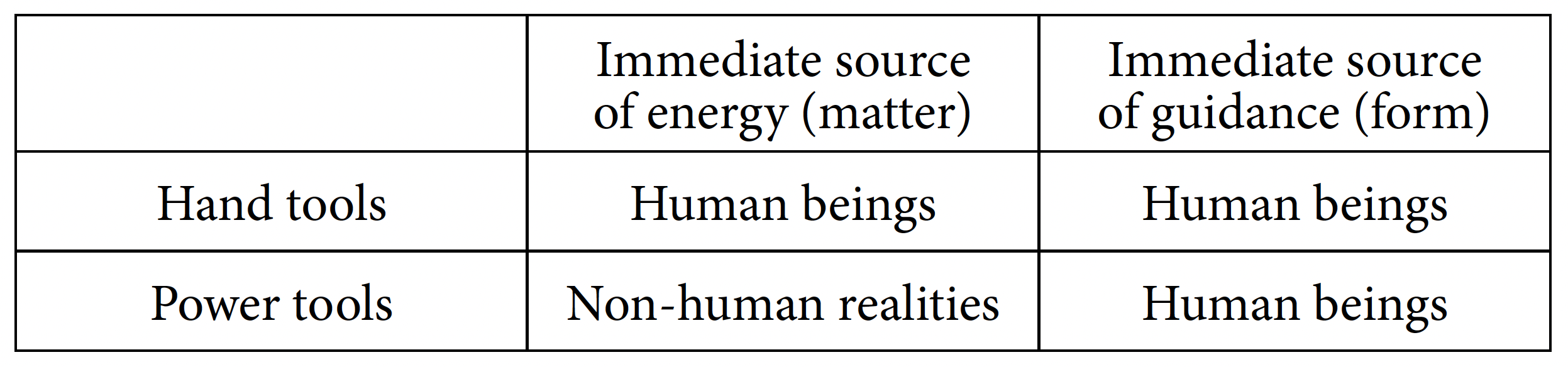
Although Illich fails to make what might have been a useful reference to Mumford's broader spectrum of distinctions, he nevertheless provides a pointed analysis of the inner charac-ter of two types of tools and the ways these differential inner structures constrain human engagements, independent of particular intentions, good or bad.For Illich, tools embody or express not only the intentions of individual human mak-ers and users, but also, and equally significantly, they embody what may perhaps perversely be termed “unintended inten-tions” - which, for that very reason, must be investigated. There is the need for a phenomenology of the artificial related to but not limited by concerns for the effective manipulation and management of artifacts.
As operating or functional entities, tools can be ana-lyzed into material and formal elements. Energy constitutes a kind of prime matter of motion, providing the raw or un-formed impulse for operating; while guidance, operating of course through the tool itself, gives the functioning of any tool a formal definition.23)Because of dependence on human users for both the material and formal elements of their functioning, hand tools exhibit a unique dependency on and qualitatively distinct engagement with human beings. Insofar as the energy to operate power tools becomes independent of human users, such tools begin to exhibit a certain autonomy of any individual user. Moreover, because power tools concentrate increasingly greater quanta of energy in the hands of users, they necessarily introduce into the social order in-equalities that would otherwise not be present.
This sketch of a contribution to the phenomenology of artifacts begins to reveal a straightforward sense in which technology can become autonomous in relation to human us-ers (if not makers), and how a tool can have inherent characteristics that ground distinctive impacts on societal orders - independent of particular social contexts within which it might be embedded or particular social process with which it may be associated. It is also relatively simple to see the mean-ing of Illich's repeated call for new kinds of engagement tools for human beings to work with (tools employing human energy and guidance) instead of more tools to work for humans (tools requiring less and less direct human energy or guidance). The latter increasingly disallow end-users to introduce their personal intentions into the world, to leave behind traces of themselves in ways that have created the rich worlds of traditional artifice which have, in the past,served as dwelling places of humanity. Users now become consumers, and leave behind traces of themselves only in their wastes.
Moreover, with hand tools, the general bodily engagement and the dependency on human energy provide the basis for direct, intuitive, judgments about the efficacy of a particular tool in a particular context. If a hand tool does not work, the user knows it, immediately and through direct experience. To swing a dull axe, and feel in the hands and arms the throw-back of momentum that fails to be inserted into the grain of the wood, hearing at the same time a thud rather than a sharp crack, provides all the evidence the woodsman needs that a blade requires file and whetstone. As tools are transformed into machines and become vehi-cles for the utilization of energy originating outside the hu-man body, the user is reduced to operator or manipulator, and the human being is deprived of many of the direct or immediate indicators of efficacy. To compensate, to provide a new basis for judgment, human users develop a science of mechanics, with its quantified measures and gauges of efficiency. The quantification of efficacy by the input-output calculus of efficiency in tum gives birth to new construc-tions of artifice, the world of machines.
This analysis goes beyond Illich's own work, which remains no more than the suggestive initiation of a comprehensive phenomenology of artifacts and their human engagements. But, drawing on the mechanological analyses of Lafitte and Simondon, and setting aside the need to address issues of the influence of what may be called the phenom-enology of passive artifacts, one can summarize, in the fol-lowing schema, a provisional extension of Illich's thought.
![\[table pag.69 pdf Conspiratio\]](/_media/periodicals:05:mitcham:05-mitcham-02-pg69.png "\[table pag.69 pdf Conspiratio\]") Illich's hand tool-power tool distinction simplifies a conceptual gradient from tools properly so-called to cybernetic devices. Machines are first of all hand-employed tools; then tools that require energy input from gangs of laborers (as with galley slaves rowing a ship) or animals (a team of oxen pull-ing a mold board plow) or the readily accessible motions of nature (wind caught by the sail). External input undergoes further transmutation with the development of, first, the heat engine, then electricity, to drive a mechanical prime mover. The power of the steamengine almost exponentially exceeds any previous energy source; electricity takes such powers into similar realms of scientific and conceptual abstraction.
Illich's hand tool-power tool distinction simplifies a conceptual gradient from tools properly so-called to cybernetic devices. Machines are first of all hand-employed tools; then tools that require energy input from gangs of laborers (as with galley slaves rowing a ship) or animals (a team of oxen pull-ing a mold board plow) or the readily accessible motions of nature (wind caught by the sail). External input undergoes further transmutation with the development of, first, the heat engine, then electricity, to drive a mechanical prime mover. The power of the steamengine almost exponentially exceeds any previous energy source; electricity takes such powers into similar realms of scientific and conceptual abstraction.
Transmutations in guidance and formal functioning follow suit. Note, for instance, how along with the harness-ing of power from the heat engine there developed internal technical requirements for technological controls; these were initially realized in the mechanical governor, introducing a formal decoupling of human operators from actual machine operation. Such formal decoupling at the level of operation is, however, coordinate both with the emergence of the engineering analysis of mathematicized control - and with an expanded external coupling through the consumption of mass-produced products. At the same time, it may well be that electrical and electronic power tools such as kitchen appliances and personal computers reintroduce a degree of individualized control that was not possible with large-scale, steam-powered industrial machines.
Against such a background one can begin to identify certain necessary refinements in Illich's program, as well as trajectories for future research, and some weaknesses.
First, Illich's statement that “the distinction between convivial and manipulatory tools is independent of the level of technology of the tool” (p. 22) calls for clarification. Surely the larger implication of his analysis is that this is not the case; traditional tools are inherently more convivial than modem machines, which are technologically more advanced.
Second, there are strong grounds for questioning Illich's broad conception of a tool as covering simple andcom-plex physical artifacts and social institutions, first-order and second-order tools. This is an idea that Illich shares, remarkably enough, with the American Pragmatists. John Dewey, for instance, argues that all human activities - whether the mak-ing and using of artifacts, the forming of social institutions, or even rational inquiry - constitute kinds of tools.24) Human activity engaged with anything in any way is instrumental for the achievement of some human value. The difficulty with such an approach is that it obscures the need for different kinds of analyses when dealing with material objects and so-cial institutions, not to mention thinking and methods of inquiry - each of which becomes convivial or nonconvivial in quite distinctive ways. With social institutions, for instance, it is quantity of individual interactions and bureaucratic line and staff structures that are central, not quanta of energy in-put and technical control mechanisms.
Finally, granted a distinction between material arti-facts and social institutions, the unique interest Illich shares with Anders comes more clearly into view. A number of phi-losophers - most notably, Hans Jonas have raised and reflect-ed on the impact of technology on ethics and the need to expand ethical concepts to take account of choices and actions made possible and prevalent by modem technology.25) Yet in most cases the focus has remained,as in traditional ethics, on human action, however technologically influenced or mod-ified. With Anders and Illich the focus goes beyond human action to consider the inner character of tools and technology in relation to fundamental ethical principles - deontological and utilitarian, respectively.
Illich's insight in this area nevertheless remains paradoxical if not problematic. Although the paradox cannot be explored here in any depth, the following may fairly be noted. There is a gap between Mill's formulation of a principle for limiting political action on others and Illich's attempt to adapt that principle to limiting the construction of tools which in-fluence the lives of self and others. To some extent the prob-lems are inherent in Mill's own theory of liberty. A negative principle against X actions or constructions is not the same as a positive principle for non-X actions and constructions. Although No S is P is equivalent to S is non-P by obversion, the logic of imperatives does not allow a move from Do not do X to Do non-X. Furthermore, the connection between Mill's ideal of diversity in individual human development may be at most contingently connected with his principle prohibiting harm or interference with others, except for self-protection. Indeed, if human beings by nature live in community, then the protection of communities may well take priority over individual liberty as the only way to support profound diversity. Illich also fails to give any serious consideration to the way Mill's principle has become itself an ideological support for that advanced and advancing technological individualism which is only an appearance of diversity.26)
The essential insight of Tools for Conviviality remains that tools, as material objects, matter. It is not just intentions that count; it is also tools - not wholly independent of, but at least as an independent variable with end-user intentions. Different types of tools influence in morally and politically significant respects what end-users can and cannot do, and how they can and cannot do it. The social process of making and using tools reflects the tools used in the making and us-ing as well as social contexts and processes. Indeed, the struc-ture of the tools may well be the more fundamental issue. This constitutes (as it were) an inversion of and challenge to received wisdom regarding relations between material entities and human intentions. In the popular wisdom, entities do not matter, intention does. “Technology is neutral.” “Guns don't kill people, people do.” Illich, like everyone else, grants that intentions matter, but not in ways that provide comfort for the status quo regarding technological objects. Indeed,Illich's intention is to promote precisely the insight that will alter not just accidental uses (which remain contingently dependent on good will, and in many instances are opposed and resistant to the inner structures and implications of artifacts) but the things themselves - and, thereby, essential use.
3. Influence
The influence of Tools for Conviviality is - given Illich's carefully crafted argument and the significance of its insights - exceptionally limited. The book has been largely overlooked by philosophers of technology who share Illich's fundamental concern. Its only serious impact has been in discussions surrounding the idea of alternative technology.
The issue here is not the influence of Illich's work in general, nor the general intellectual and cultural appreciation of Tools for Conviviality. The issue is the influence of this one text in the field of philosophy.
Yet as background to this restricted concern, consider first some more general observations. According toDisserta-tion Abstracts there have been, up through 1988, twenty-five dissertations on the work of Illich.27) Of these twenty-five dissertations, sixteen have been in the area of education, only one in philosophy. Others are scattered about in such fields as sociology (three instances), mass communications, urban planning, theology, anthropology, and social work. This is a reasonably accurate indication of the relative weights given to the various aspects of Illich's work by the scholarly academic community, at least in the United States.
In Illich's citation indices for the social sciences and for the arts and humanities, a similar range occurs. The books most often cited are Deschooling Society and, to almost as great an extent, Medical Nemesis. Indeed, it is surprising that, given the number of citations of Medical Nemesis, there have been no dissertations on that work. (Perhaps the explanation is just that graduate education in the medical community does not produce dissertations, while graduate study in education does.)
Following this summary measure of the general influence of Illich's work, consider the specific area of philosophy. In the United States and in the English-speaking world gen-erally, The Philosopher's Index is the best single bibliographic reference. Up through 1973 The Philosopher's Index contains no references to any work by or about Illich. In 1974 there is one citation of an article on Deschooling Society.28) In 1975 there are three citations of articles on Deschooling Society.29) In 1976 there is a reference to one article replying to a 1975 citation.30) The first five citations of articles on Illich in The Philosopher's Index from 1974 to 1976 are all to Deschooling Society.
Between 1974 and 1976 the only article by Illich in The Philosopher's Index is one on medicine.31) There is also one citation of a review of Medical Nemesis in 1976.32) In 1977 an article appears discussing a thesis which becomes part of Med-ical Nemesis.33) During 1978 and 1979 Illich falls completely out of The Philosopher's Index- no articles about, by, or reviews of - to reappear with three more articles on Deschooling Society in 1980,34) one in 1981,35) two in 1982.36) In 1981 there are two citations of articles by Illich in a Belgian philosophy journal,37) but there are no other articles by or reviews of Illich books during these three years. From 1983 to 1989 there are no articles on nor reviews of Illich's work, although Medical Nemesis is cited as a book in 1985 and a contribution to an edited collection is listed in 1986.38) The discussion of Illich in the professional philosophical literature focuses almost exclusively on Deschooling Society, and peaks in the mid-1970s. The first and so far only article in English to undertake philosophical discussion of Tools for Conviviality is one by Anthony Weston which does not appear until late 1989.39)
That the philosophical literature has not been avoid-ing issues Illich seeks to address in Tools forConviviality can be shown by noting that from 1985 to 1989 The Philosopher's Index cites more than fifty articles per year on technology. In 1989, for instance, there are references to eighty-four articles on technology. The dearth of philosophical literature on Illich also cannot be explained as a function of his failure to publish in philosophical journals or to teach in a university philosophy department. Neither Jacques Ellul nor Herbert Marcuse fulfilled such criteria, yet their work is widely criticized and considered philosophical. It is simply the case that in the English-speaking philosophical literature on technology Illich's work is singularly overlooked and ignored.
The Repertoire bibliographique de la philosophie is the major international index to philosophical literature in European languages. Again, through 1975 there are no articles about or by Illich. In 1976 the first articles appear: one on, another by Illich.40) The 1977 edition cites one article41) and three books.42) The 1977 Repertoire bibliographique also cites the Spanish and Italian translations of Tools of Conviviality and the Spanish edition of Energy and Equity.
This indicates a recognition of philosophical importance that Illich has not been accorded by The Philosopher's Index. Indeed, from 1977 Illich's books and the translations of his books, articles by and about, and reviews appear regularly in the Repertoire bibliographique. In the European philosoph-ical community, once Illich is recognized as a philosophical author, this recognition is sustained from the late 1970s on-ward. It is also the case, however, that Tools for Conviviali-ty fails to occupy a place of prominence in this recognition, which focuses much more attention on Medical Nemesis.43)
Despite these oversights it is perhaps appropriate to note that bibliography in the special field of philosophy and technology studies has, from an early period, recognized the relevance of Illich's work44) - although this has done nothing to promote its philosophical consideration.
As already suggested, the only body of literature that has accorded Tools for Conviviality any substantial attention is that associated with the alternative technology movement. The widely used collection of readings, Stepping Stones: Appropriate Technology and Beyond (1978),45) includes a selec-tion from Tools for Conviviality. In the late 1970s Valentina Borremans, an associate of Illich at CIDOC, edited a 112-page Guide to Convivial Tools.46) Interestingly enough, Borremans includes as relevant references to all of Illich's books to that point. In 1982 Malcom Hollick's ''The Appropriate Technology Movement and Its Literature: A Retrospective“ also gives Tools for Conviviality prominent consideration.47)
The real influence of this text has been not in the phil-osophical literature, but - appropriately enough - among a small circle of friends, con-vivo. The disappointing paradox of this influence is that it has not promoted a continuation and deepening of the analysis of the inner structure of tools, either in later work by Illich or in that of his colleagues.
Indeed, Shadow Work, a collection of five essays, car-ries on a running critique of certain aspects of the alternative technology movement without ever advancing the critique of tools.48) Gender has a section, “Gender and Tools,” which provides historical data on the break between artifacts and gender that is part of the modem way with tools, but it gives no phenomenological description of this break or grounding for its occurrence.49) ABC does an analysis of the cultural impact of that tool known as writing, but not in such a way as to deepen principles developed in Tools for Conviviality. Indeed, the trajectory of Illich's thought moves away from concern for the inner character of tools and toward an emphasis on their external relations - specifically their impact, not on social institutions and relationships, so much as on self-under-standings and self-images.
There exists, however, a tradition of artifactist thought after Tools for Conviviality (1973), which includes at least the following:
Langdon Winner, *Autonomous Technology: Technics-Out-of-Control as a Theme in Political Thought* (1977) and *The Whale and the Reactor: A Search for Limits in an Age of High Technology* (1986).
Don Ihde, *Technics and Praxis* (1979) and *Existential Tech-nics* (1983).
Mihaly Csikszentmihalyi and Eugene Rochberg-Halton, *The Meaning of Things: Domestic Symbols and the Self* (1981).
Albert Borgmann, *Technology and the Character of Contemporary Life: A Philosophical Inquiry* (1984).
What is disappointing is that in none of these books has any serious use been made of the work of Illich.
Consider Langdon Winner. His initial book, Auton-omous Technology, published in 1977, four years after Tools for Conviviality, accords Illich only the most casual mention.54)
Autonomous Technology: Technics-out-of-Control as a Theme in Political Thought is an extended defense and elaboration of a thesis found most fully articulated in Ellul's The Technological Society - the idea that the rise of modern technology is coordinate with the creation of a new form of political life, which Winner calls “technological politics.” Although his overlooking of Illich might be explained as a result of Winner's focus on analyzing the technological politics characteristic of what Ellul terms the technical milieu, Illich's description of politics after the second watershed in technical development corresponds precisely to these two other descriptors. Illich's further analysis of the specific autonomies of certain kinds of tools and the concrete implications that flow from their inner structures, not to mention his conception of justice and the politics of inversion, open further complementary avenues for analysis. Moreover, the same year thatWinner's work appeared also witnessed the publication of Ellul's The Techno-logical System, an extended revision and commentary on the first two chapters of The Technological Society. Unlike Winner, Ellul does give Illich considerable attention, quoting him at length on four different occasions.55)
The common ground between Winner and Illich is noted by Anthony Weston in the sole philosophical analysis of Tools for Conviviality yet to appear in English, already men-tioned. Weston identifies three ways that Illich's fundamental criteria of conviviality apply to tools. For Illich, a tool is con-vivial if it
(1) can be freely chosen,
(2) is an active expression of personal life, and
(3) is not monopolized by some professional elite.
Winner, in the last chapter of his book, introduces without much argument three guidelines that might be incorporated into an “epistemological Luddism” for questioning and rein-troducing into technological politics some of the character of traditional political life. These would examine technologies in terms of their
(a) intelligibility to non-experts,
(b) degrees of flexibility, and
(\c) tendency to foster dependency.56)
As Weston observes, Winner's (a) corresponds to Illich's (3), Winner's (b) to Illich's (1), and Winner's © to Illich's (2).57)
The difference between Winner and Illich is that Win-ner is primarily analyzing that literature which focuses the problem of autonomous technology for political reflection and only secondarily the problem of technology itself; on the other hand, Illich, like Ellul, is dealing in the first place with the problem of technology.
Winner's second book, The Whale and the Reactor, is not significantly different in this regard. It mentionsIllich, but only twice and in passing.58) “Do Artifacts Have Politics?,” the central chapter of the first and controlling section of the book, could have been deepened and strengthened by an engagement with the central argument ofTools for Conviviality. Originally published in 1980, “Do Artifacts Have Politics?” considers two ways in which artifacts can embody political implications. In the first, human beings specifically make technologies solve political problems. He cites the examples of Robert Moses's Long Island parkway overpasses, which were designed to restrict use by buses and thus access by the poorer classes of the city; Cyrus McCormick's molding ma-chines, utilized to break shop floor labor organization; and the mechanical tomato harvester, which turned truck farming into agribusiness.
The things we call "technologies" are ways of building order in our world. … Consciously or unconsciously, deliberately or inadvertently, societes choose structures for technologies that influence how people are going to work, communicate, travel, consume, and so forth over a very long time. In the processes by which structuring decisions are made, different people are situated differently and possess unequal degrees of power as well as unequal levels of awareness…For that reason the same careful attention one would give to the rules, roles, and relation-ships of politics must also be given to such things as the building of highways, the creation of television networks, and the tailoring of seemingly insignificant features of new machines.
In comparison with Illich's argument and its urgency, this simple call for more carefulness in tool making and using sounds like a weak platitude.
In the second case, there are technologies which, in-dependent of any human intention, embody certain inherent political implications. Here Winner cites the arguments of Engels, Plato, and Marx (in that order) and then distinguishes strong and weak versions of this thesis. In the strong version, a certain technology is said to require or necessitate some specific social relations. In the weak version, a technology is argued not to require but to be strongly compatible with spe-cific social relations. “My belief that we ought to attend more closely to technical objects themselves is not to say that we can ignore the contexts in which those objects are situated.”60) But in neither version does Winner analyze the inner structure of modem tools. In comparison with Illich, his analysis remains oriented toward theoretical discussion and external relations.
Consider also Don Ihde. Neither Technics and Praxis nor Existential Technics makes any reference to Illich. On the one hand, this is more understandable than with Win-ner; Ihde analyzes not so much discussions about the politics of tools as tools in scientific research and, to some moderate extent, leisure. On the other hand, Illich himself also provides insights into the phenomenology of human-technology interactions that complement Ihde's work. Ihde's work, like Illich's, is focused more on the using of tools than on their making; but unlike Illich, Ihde is concerned primarily with scientific instrumentation or the cognitive use of tools to the exclusion of more quotidian engagements such as education, transportation, and medicine.
Technics and Praxis, for instance, considers in detail the ways in which tools or instruments can extend human capability (compare Tools for Conviviality, pp. 84-85) and, in the process, also restrict access to the world (a point Illich does not develop) through a simultaneous amplification-reduction structure. Ihde uses the example of a dentist's probe which, as a small metal rod with a pointed tip, is able to detect irregularities in a tooth that a finger would not be able to sense.
But at the same time that the probe extends and amplifies, it *reduces* another dimension of the tooth experience. With my finger I sensed the warmth of the tooth, its wet-ness, etc., aspects which I did not get through the probe at all. The probe, precisely in giving me a finer discrimi-nation related to the micro-features, "forgot" or reduced the full range of other features sensed with my finger's touch.
The probe embodies or extends finger or hand. But instru-ments not only enter into what Ihde thereby terms embod-iment relations; they also take on hermeneutic relations. In the relation
Human ➔ Instrument ➔ World
the instrument can be assimilated to a human-instrument combination so that the user and instrument together con-front or interpret the world thus:
[Human-Instrument] ➔ World.
But human users can also place themselves over against the instrument, now viewed as part of the world, and thus enter into a hermeneutic or interpretative relationship directly with the instrument-world:
Human ➔ [Instrument-World].
Eyeglasses are engaged in embodiment relations, electron microscopes in hermeneutic relations.
Ihde's consideration of how concrete things such as dental probes, telephones, magnifying glasses, microscopes, electron microscopes, telescopes, electronic music instru-ments, or computers exhibit such relationships can be cor-related with Illich's concerns for the ways power amplification entails freedom reduction. The move in Existential Technics toward consideration of how technical engagements influ-ence human self-understandings can be correlated as well with emphases more prominent in Illich's later work.
Ihde, however, simply analyzes the differences between these two human experiences of instruments without explaining their ground in different kinds of tools. But clearly what Illich identifies as the difference between hand tools and power tools begins to provide this explanation. Hand tools are more amenable to embodiment relations, whereas power tools tend to require hermeneutic relations.
Like the later Illich and the Ihde of Existential Technics, Mihaly Csikszentmihalyi and Eugene Rochberg-Halton are concerned with the relation between things and self-understandings. In their words,
Men and women make order in their selves…by first creating and then interacting with the material world. The nature of that transaction will determine, to a great extent, the kind of person that emerges. Thus the things that surround us are inseparable from who we are. The material objects we use are not just tools we can pick up and discard at our convenience; they constitute the framework of experience that gives order to our other-wise shapeless selves.
Their focus, however, is on household things and their sym-bolic import. It is nevertheless remarkable that in a compre-hensive survey of previous approaches to an understanding of things that considers psychological, anthropological, and sociological studies there is no mention of the approach represented by Illich (or Ihde, for that matter).
At the same time, by raising the question of the sym-bolic import of things, Csikszentmihalyi and Rochberg-Hal-ton re-present the challenge of immaterialism associated per-haps most often with Baudrillard. This challenge concerns the relation between the inner structure, the functional, and the symbolic characters of artifacts,and is crucial to Illich's argu-ment for self-learned self-limitation in the making and using of technology. Any attempt to focus ethical-political reflec-tion on material artifacts - especially one arguing for the experiential learning of self limitations - must address the counterthesis of Baudrillard and others regarding the immaterial, sign character of contemporary objects. For Baudrillard, for instance, “There are no limits to consumption”63) because mod-ern things are more like words than physical objects. Just as conversation is inherently limitless, so is modern consumption.
[W\]e want to consume more and more. \[Read: "We want to talk more and more."\] This compulsion to consume \[to talk\] is not the consequence of some psychological deter-minant ... nor is it simply the power of emulation. It is a total idealist practice which has no longer anything to do (beyond a certain point) with the satisfaction of needs, nor with the reality principle; it becomes energized in the ... object-signs of consumption… Hence, the desire to"moderate" consumption or to establish a normalizing network of needs is naive and absurd moralism.
Albert Borgmann's explication of contemporary artifacts in terms of what he calls the device paradigm perhaps provides the beginning of an analytic response. Borgmann also, alone among serious philosophers of artifice writing in the wake of Tools for Conviviality, grants it a measure of recognition - even while he takes issue with at least one thesis of the text.65)
Borgmann contrasts traditional things with modern devices.
A thing ... is inseparable from its context, namely, its world, and from our commerce with the thing and its world,namely, engagement. The experience of a thing is always and also a bodily and social engagement with the thing's world.
A device, by contrast, seeks to realize the promise of technology “to bring the forces of nature and culture under control, to liberate us from misery and toil, and to enrich our lives”67) in a material object cut loose from all bodily and social engage-ment. In contrast with a fireplace, for example, “a centralheating plant procures mere warmth and disburdens us of all other elements.”68) In its very disburdenment, the device takes on a disembodied or immaterialized character, like a word or a sign.
But human beings are not just the users of words and signs; they are embodied beings whose lives are realized through what Borgmann calls focal things and practices. While recognizing, with Baudrillard, the presence and influ-ence of devices, Borgmann nevertheless, like Illich, calls for
the recognition and restraint of the \[device\] paradigm. To restrain the paradigm is to restrict it to its proper sphere. Its proper sphere is the background or periphery of fo-cal things and practices. Technology so reformed is no longer the characteristic and dominant way in which we take up with reality; rather it is a way of proceeding that we follow at certain times and up to a point, one that is left behind when we reach the threshold of our focal and final concerns.
According to Borgmann, such a reform will take place not out of crisis so much as out of focal concern. It is not the stick of necessity so much as the carrot of “the significance of things and the dignity of humans”70) that can lead from a nonconvivial to a convivial world. Whether this is as true in the world dominated by power tools as it is in a world of hand tools is perhaps another issue to be addressed by artifactist thought.
Although the direct influence of Tools for Convivi-ality has been limited, still a diversity of collateral thinkers testify to the need for and vitality of its artifactist program, and to the need for common cause across more than one philosophical perspective. Illich's insight may not yet have been accorded explicit acknowledgment as a contribution to the phenomenology of artifacts, but then the common pursuit of this reflection has taken on none of the features of an old or established discourse. As the phenomenology of artifacts emerges into shared conversation, it may well be that Tools for Conviviality will be able to play a role. As argument, it remains young.
2)
According to Illich’s commentary (see note 1), Energy and Equity was “written at the request of Marion Boyars by expanding an article published in Le Monde.
3)
Examples:
From Medical Nemesis (New York: Pantheon, 1976), p. 5: This book “uses a model of social assessment of technological progress that I have spelled out else-where [footnote references Tools for Conviviality] and applied previously to education [footnote references Deschooling Society] and transportation [footnote references Energy and Equity], and that I now apply to the criticism of the professional monopoly and of the scientism in health care.”
From Toward a History of Needs (New York: Pantheon, 1978), p. ix: “The first es-say [“Energy and Equity”] is a postscript to my book Tools for Conviviality (New York,1973).”
From Shadow Work (Boston: Marion Boyars, 1981), p. 4: “In Tools for Con viviality, I called attention to how the environment is ruined for use-value oriented action by economic growth.”
Tools for Conviviality is also the only book that has been the basis for the pub-lica tion of another book by a student of Illich’s work. See Valentina Borremans’ Refer-ence Guide to Convivial Tools, Special Report no. 13 (Library Journal, 1980), with a preface by Illich. The Guide itself is referenced in Gender (New York: Pantheon,1982), p. 18.
From Medical Nemesis (New York: Pantheon, 1976), p. 5: This book “uses a model of social assessment of technological progress that I have spelled out else-where [footnote references Tools for Conviviality] and applied previously to education [footnote references Deschooling Society] and transportation [footnote references Energy and Equity], and that I now apply to the criticism of the professional monopoly and of the scientism in health care.”
From Toward a History of Needs (New York: Pantheon, 1978), p. ix: “The first es-say [“Energy and Equity”] is a postscript to my book Tools for Conviviality (New York,1973).”
From Shadow Work (Boston: Marion Boyars, 1981), p. 4: “In Tools for Con viviality, I called attention to how the environment is ruined for use-value oriented action by economic growth.”
Tools for Conviviality is also the only book that has been the basis for the pub-lica tion of another book by a student of Illich’s work. See Valentina Borremans’ Refer-ence Guide to Convivial Tools, Special Report no. 13 (Library Journal, 1980), with a preface by Illich. The Guide itself is referenced in Gender (New York: Pantheon,1982), p. 18.
4)
Energy and Equity (New York: Harper & Row, 1974) will also be published in this series. This will not be the case for any subsequent Illich book.
5)
See, e.g., Valerie Mike, “Toward an Ethics of Evidence - and Beyond: Observations on Technology and Illness,” Research in Philosophy and Technology 9 (1989): 101-113.
6)
See John Stuart Mill, On Liberty (1859), chapter 1, paragraph 9: ‘Toe object of this essay is to assert one very simple principle … that the sole end for whichmankind is warranted, individually or collectively, in interfering with the liberty of action of any of their number, is self-protection.”
7)
Wolfgang Sachs, ‘’The Gospel of Global Efficiency: On Worldwatch and other Reports on the State of the World,” privately circulated article, a highly edited version ofwhich ap-peared as “A Critique of Ecology,” New Perspectives Quarterly 6, no. 1 (Spring 1989): 16-19.
8)
Ivan Illich and Barry Sanders, ABC: The Alphabetization of the Popular Mind (San Francisco: North Point Press, 1988).
9)
Ernst Kapp, in Grundlinien einer Philosophie der Technik (1877), the first book to de-velop an explicit philosophy of technology, stressed the former view.
10)
Ivan Illich, Celebration of Awareness: A Call for Institutional Revolution (Garden City, N.Y.: Doubleday, 1970).
11)
Jacques Lafitte, Reflexions sur la science des machines (Paris: Bloud et Gay, 1932; reprinted Paris: J. Vrin, 1972); English translation by John Hart and Jean LeMoyne, Reflections on the Science of Machines ([London, Ontario, Canada] Mechanology Press, n.d.). Gilbert Simondon, Du mode d’ existence des objets techniques(Paris: Aubier, 1958; reprinted 1969, 1989). For commentary see Carl Mitcham, “Documentation: Analysis of Machines in the French Intellectual Tradition (Espinas,Lafitte, Weil),” Research in Philosophy and Technology 2 (1979): 189-234.
12)
Jacques Ellul, La Technique ou I’ enjeu du siecle (Paris: Colin, 1954), chapter 2, section 2. English translation by John Wilkinson: The Technological Society (New York: Knopf, 1964). See also the two-part update of this seminal text: Le systeme tecnicien (Paris: Calmann-Levy, 1977), English translation by Joachim Neugroschel,The Technological System (New York: Continuum, 1980); and Le bluff technologique (Paris: Hachette, 1988); English translation by Geoffrey W. Bromiley, The Technologi cal Bluff (Grand Rapids, Mich.: Eerdmans, 1990).
13)
Gunther Anders, “Commandments in the Atomic Age,” in Burning Conscience
(London: Weidenfeld and Nicolson, 1961), p. 18. Italics added.
(London: Weidenfeld and Nicolson, 1961), p. 18. Italics added.
14)
Lewis Mumford, “Authoritarian and Democratic Technics,” Technology and Culture 5, no. I (Winter 1964): 1-8.
15)
Marshall McLuhan, Understanding Media: The Extensions of Man (New York: McGraw-Hill, 1964), especially chapter 1,“Medium Is the Message.”
16)
Jean Baudrillard, Le systeme des objets (Paris: Gallimard, 1968).
17)
Herbert A. Simon, The Sciences of the Artificial (Cambridge, Mass.: MIT Press, 1969; second, expanded edition, 1981).
18)
Richard Weaver, “Humanism in an Age of Science,” ed. Robert Hamlin, Intercollegiate Review 7, nos. 1-2 (Fall 1970): 15. (Both Anders and Weaver are reprinted in C.Mitcham and R. Mackey, eds., Philosophy and Technology, New York: Free Press, 1972, 1983, pp. 130-135 and 136-142, respectively.
19)
For an appraisal of the necessity and benefit of artifice, see Jacques Ellul, ‘’Tech-nique and the Opening Chapters of Genesis,” in Carl Mitcham and Jim Grote, eds.,The-ology and Technology (Lanham, Md: University Press of America, 1984), pp. 123-138.
20)
See, e.g., Marshall McLuhan and Quentin Fiore. with Jerome Agel, The Medium ls the Massage (New York: Bantam, 1967).
21)
See Mario Bunge’s Scientific Research (New York: Springer, 1967), vol. 2: The
Search for Truth, Part 3, chapter 11, “Action,” for a distinction between substantive and op-erative applications of science, with the latter constituting scientific studies ofmachines and human-machine interactions which is another way of describing Simon’s interest.
Search for Truth, Part 3, chapter 11, “Action,” for a distinction between substantive and op-erative applications of science, with the latter constituting scientific studies ofmachines and human-machine interactions which is another way of describing Simon’s interest.
22)
Lewis Mumford, Technics and Civilization (New York: Harcourt, Brace & World, 1963; first published 1934), p. 11.
23)
Extending this analysis, which obviously adapts terms from Aristotelian meta-physics, one could describe the tool as signate matter. Then one could also say that the more technologically advanced the tool, the more signate its matter; and thus the more determined its motion.
24)
See, e.g., the discussion in Larry A. Hickman’s John Dewey’s Pragmatic Technology
(Bloomington: Indiana University Press, 1990).
(Bloomington: Indiana University Press, 1990).
25)
See especially Hans Jonas, The Imperative of Responsibility: In Search of an Ethics for the Technological Age, trans. Hans Jonas and David Herr (Chicago: University ofChica-go Press, 1984).
26)
See Robert Paul Wolff, Barrington Moore, Jr., and Herbert Marcuse, A Critique of Pure Tolerance (Boston: Beacon, 1965; 2d edition, 1969), for a critical response to Mill’s principle.
27)
The dissertations in question:
(1) Barbara Welch, “Being-in-the-Body: A Reflection upon American Self Med-ication Drug Advertising,” Ph.D. dissertation, Mass Communications, University of Iowa, 1984. Pp. 412.
(2) Michael O’Neill, “Innovative Practices in State Funded Community Health Agencies: The Case of Quebec’s Community Health Departments,” Ph.D. dis-sertation, Sociology, Boston University, 1986. Pp. 514.
(3) Wouter Turpijn, “In de Schaduw van de Volkshuisvesting: Een Studie over de Zelfwerkzaamheid van Bewoners” [Shadow-housing: A study of self help among residents], Ph.D. dissertation, Urban and Regional Planning, Rijksuni-versiteit te Utrecht (The Netherlands), 1987. Pp. 225.
(4) David Nicholas James, “What Is Professional Ethics?,” Ph.D. dissertation, Philosophy, Vanderbilt University, 1981. Pp. 183.
(5) Robert Blythe Bowden, “The Development and Utilization of a School Operation Instrument,” Ed.D. dissertation, Education, Catholic University of America, 1981. Pp. 157.
(6) Burt David Braunius, “Participatory Research for Curriculum Building: Es-tablishing Intentions in Adult Religious Education,” Ph.D. dissertation, Educa-tion, Michigan State University, 1983. Pp. 253.
(7) Edward Cosmo Matranga,“Radical Educational Reform and Alternatives to Schooling in Revolutionary Mexico,” Ph.D. dissertation, Education, University of Connecticut, 1981. Pp. 279.
(8) Charles Jeffrey Mitchiner, “From Frustrated Bureaucrat to Radical Critic: Everett Reimer’s Case Against Public Schooling,” Ph.D. dissertation, Education,
Georgia State University, 1981. Pp. 383.
(9) Kenneth Henry Luebbering, “Learning for Nowhere: Educational Thought in Anarchist Tradition,” Ph.D. dissertation, Education, University of Missouri, 1980. Pp. 224.
(10) Michele Geslin Small, “Education for a Systems Age,” Ph.D. dissertation, Education, University of Minnesota, 1983. Pp. 189.
(11) James Hardy Barr, Jr., “Education for the Handicapped in the Arabian Pen-insula: Issues and Trends,” Ed.D. dissertation, Education, Columbia University Teachers College, 1983. Pp. 170.
(12) George Harrison Wood, II, “Schools, Social Change, and the Politics of Paralysis,” Ph.D. dissertation, Education, University of Illinois at Urbana Cham-paign, 1981. Pp. 125.
(13) Terry Price Harter, “A Critique of North American Protestant Theological Education from the Perspectives of Ivan Illich and Paulo Freire,” Ph,D. disser-tation, Theology, Boston University Graduate School, 1980. Pp. 338.
(14) John Nelson Fritz, “A Comparative Study of Health and Medical Practices in Two Rural lntermountain Communities,” Ph.D. dissertation, Anthropology, University of Utah, 1984. Pp. 314.
(15) Marc Lewis Berk, “The Limits of Medicine: The Distribution of Medical Resources and its Effect on Health Outcomes,” Ph.D. dissertation, Sociology, New York University, 1981. Pp. 165.
(16) Juanne Elizabeth Nancarrow Clarke, “Medicalization in the Past Century in the Province of Ontario: The Physician as Moral Entrepreneur,” Ph.D. disser-tation, Sociology, University of Waterloo, 1980.
(17) Colette Frances Kung, “Illich’s Learning Web Theory and its implications for Development for the Rural Regions of Malaysia,” Ph.D. dissertation, Educa-tion, Loyola University of Chicago, 1979. Pp. 159.
(18) Charles Raymond Schindler, “A Philosophical Analysis of Ivan Illich’s Con-struct, ‘Deschooling Society’ and Related Terms,” Ph.D. dissertation, Education, Michigan State University, 1972. Pp. 96.
(19) John Richard Minnis, “A Study of the Concept Lifelong Learning Based on a Comparative Analysis of the Philosophy and Educational Thought of
Edward C. Lindeman, Malcom S. Knowles, and Ivan D. Illich,” Ph.D. dissertation, Education, Florida State University, 1975. Pp. 222.
(20) William Iderson Johnson, “Hermetic Alchemy as the Pattern for Schooling Seen by Ivan Illich in the Works of John Amos Comenius,” Ph.D. dissertation, Education, Ohio State University, 1973. Pp. 168.
(21) Kurt William Holderied, “Ivan Illich and Contemporaries: Comparing Views of School Reform,” Ed.D. dissertation, Education, Marquette University, 1975.Pp. 383.
(22) Robert William McGurrin, “The Sociological, Philosophical, and Educa-tional Thought of Ivan Illich and Adam Curle,” Ed.D. dissertation, Education, University of Southern California, 1978.
(23) Lucille C. Bruch, “Deschooling and Retooling: An Examination of the Philosophy of Ivan Illich with Particular Emphasis on his Analysis of the Structures of Society,” Ph.D. dissertation, Education, Michigan State University,
1974. Pp. 112.
(24) John Lawrence Elias, “A Comparison and Critical Evaluation of the Social and Educational Thought of Paulo Freire and Ivan Illich, with a Particular Emphasis upon the Religious Inspiration of their Thought,” Ph.D. disserta tion, Education, Temple University, 1974. Pp. 215.
(25) Salim Akhtar Sharif, “The Problem of Poverty in Rural India: A Proposed Model in the Community Development Program of India, Using the Pedagogy of the Consciousness Raising (Paulo Freire’s and Ivan Illich’s Educational Methods) and Growth Group Models,” D.Min. dissertation, Social Work, Clare-mont School of Theology, 1976. Pp. 103.
(1) Barbara Welch, “Being-in-the-Body: A Reflection upon American Self Med-ication Drug Advertising,” Ph.D. dissertation, Mass Communications, University of Iowa, 1984. Pp. 412.
(2) Michael O’Neill, “Innovative Practices in State Funded Community Health Agencies: The Case of Quebec’s Community Health Departments,” Ph.D. dis-sertation, Sociology, Boston University, 1986. Pp. 514.
(3) Wouter Turpijn, “In de Schaduw van de Volkshuisvesting: Een Studie over de Zelfwerkzaamheid van Bewoners” [Shadow-housing: A study of self help among residents], Ph.D. dissertation, Urban and Regional Planning, Rijksuni-versiteit te Utrecht (The Netherlands), 1987. Pp. 225.
(4) David Nicholas James, “What Is Professional Ethics?,” Ph.D. dissertation, Philosophy, Vanderbilt University, 1981. Pp. 183.
(5) Robert Blythe Bowden, “The Development and Utilization of a School Operation Instrument,” Ed.D. dissertation, Education, Catholic University of America, 1981. Pp. 157.
(6) Burt David Braunius, “Participatory Research for Curriculum Building: Es-tablishing Intentions in Adult Religious Education,” Ph.D. dissertation, Educa-tion, Michigan State University, 1983. Pp. 253.
(7) Edward Cosmo Matranga,“Radical Educational Reform and Alternatives to Schooling in Revolutionary Mexico,” Ph.D. dissertation, Education, University of Connecticut, 1981. Pp. 279.
(8) Charles Jeffrey Mitchiner, “From Frustrated Bureaucrat to Radical Critic: Everett Reimer’s Case Against Public Schooling,” Ph.D. dissertation, Education,
Georgia State University, 1981. Pp. 383.
(9) Kenneth Henry Luebbering, “Learning for Nowhere: Educational Thought in Anarchist Tradition,” Ph.D. dissertation, Education, University of Missouri, 1980. Pp. 224.
(10) Michele Geslin Small, “Education for a Systems Age,” Ph.D. dissertation, Education, University of Minnesota, 1983. Pp. 189.
(11) James Hardy Barr, Jr., “Education for the Handicapped in the Arabian Pen-insula: Issues and Trends,” Ed.D. dissertation, Education, Columbia University Teachers College, 1983. Pp. 170.
(12) George Harrison Wood, II, “Schools, Social Change, and the Politics of Paralysis,” Ph.D. dissertation, Education, University of Illinois at Urbana Cham-paign, 1981. Pp. 125.
(13) Terry Price Harter, “A Critique of North American Protestant Theological Education from the Perspectives of Ivan Illich and Paulo Freire,” Ph,D. disser-tation, Theology, Boston University Graduate School, 1980. Pp. 338.
(14) John Nelson Fritz, “A Comparative Study of Health and Medical Practices in Two Rural lntermountain Communities,” Ph.D. dissertation, Anthropology, University of Utah, 1984. Pp. 314.
(15) Marc Lewis Berk, “The Limits of Medicine: The Distribution of Medical Resources and its Effect on Health Outcomes,” Ph.D. dissertation, Sociology, New York University, 1981. Pp. 165.
(16) Juanne Elizabeth Nancarrow Clarke, “Medicalization in the Past Century in the Province of Ontario: The Physician as Moral Entrepreneur,” Ph.D. disser-tation, Sociology, University of Waterloo, 1980.
(17) Colette Frances Kung, “Illich’s Learning Web Theory and its implications for Development for the Rural Regions of Malaysia,” Ph.D. dissertation, Educa-tion, Loyola University of Chicago, 1979. Pp. 159.
(18) Charles Raymond Schindler, “A Philosophical Analysis of Ivan Illich’s Con-struct, ‘Deschooling Society’ and Related Terms,” Ph.D. dissertation, Education, Michigan State University, 1972. Pp. 96.
(19) John Richard Minnis, “A Study of the Concept Lifelong Learning Based on a Comparative Analysis of the Philosophy and Educational Thought of
Edward C. Lindeman, Malcom S. Knowles, and Ivan D. Illich,” Ph.D. dissertation, Education, Florida State University, 1975. Pp. 222.
(20) William Iderson Johnson, “Hermetic Alchemy as the Pattern for Schooling Seen by Ivan Illich in the Works of John Amos Comenius,” Ph.D. dissertation, Education, Ohio State University, 1973. Pp. 168.
(21) Kurt William Holderied, “Ivan Illich and Contemporaries: Comparing Views of School Reform,” Ed.D. dissertation, Education, Marquette University, 1975.Pp. 383.
(22) Robert William McGurrin, “The Sociological, Philosophical, and Educa-tional Thought of Ivan Illich and Adam Curle,” Ed.D. dissertation, Education, University of Southern California, 1978.
(23) Lucille C. Bruch, “Deschooling and Retooling: An Examination of the Philosophy of Ivan Illich with Particular Emphasis on his Analysis of the Structures of Society,” Ph.D. dissertation, Education, Michigan State University,
1974. Pp. 112.
(24) John Lawrence Elias, “A Comparison and Critical Evaluation of the Social and Educational Thought of Paulo Freire and Ivan Illich, with a Particular Emphasis upon the Religious Inspiration of their Thought,” Ph.D. disserta tion, Education, Temple University, 1974. Pp. 215.
(25) Salim Akhtar Sharif, “The Problem of Poverty in Rural India: A Proposed Model in the Community Development Program of India, Using the Pedagogy of the Consciousness Raising (Paulo Freire’s and Ivan Illich’s Educational Methods) and Growth Group Models,” D.Min. dissertation, Social Work, Clare-mont School of Theology, 1976. Pp. 103.
28)
Ignacio L. Goetz, “On Man and His Schooling,” Educational Theory 24 (Winter 1974): 85-98. Aims to clarify, interpret, and defend Illich’s arguments in Deschooling Society.
29)
William F. Hare,“Openness in Education,” Philosophy of Education: Proceedings 30 (1974): 218-226; Brian Birchall, “Some Misconceptions in Ivan Illich,” *Educational Theory .24 (Fall 1974): 414–425; and William E. Brownson, “The Structure of Com-petition in the School and Its Consequences,” Philosophy of Education: Proceedings 30 (1974): 227-240. Hare and Brownson are sympathetic, Birchall is not.(Here, and in the relevant notes that follow, the order of citations is determined by their occurrence in The Philosopher’s Index.)
30)
Michael Micklin,“Those Misconceptions Are Not Illich’s,” Educational Theory 25 (Summer 1975): 323-329.
31)
Ivan Illich, “The Political Uses of Natural Death,” Hastings Center Studies 2 (January 1974): 18-20.
32)
Lee Nisbet, Humanist 36 (September-October 1976): 49.
33)
G. Horobin, “Commentary on Ivan Illich’s ‘The Medicalization of Life’ and Edmund Leach’s ‘Society’s Expectations of Health’,” Journal of Medical Ethics l (July 1975):
90-91. Illich’s “The Medicalization of Life” appears in the same issue, pp. 73- 77, along with another related piece.
90-91. Illich’s “The Medicalization of Life” appears in the same issue, pp. 73- 77, along with another related piece.
34)
Bruce F. Baker, “Illich and Kierkegaard Recombined,” Philosophy of Education: Pro-ceedings 34 (1978): 410-416. Leroy F. Troutner, “Illich and KierkegaardCombined,” Phi-losophy of Education: Proceedings 34 (1978): 397-409; Carl G. Hedman, “The ‘Deschool-ing’ Controversy Revisited: A Defense of Illich’s ‘Participatory Socialism’,” Educational Theory 29 (Spring 1979):.109-116.
35)
Carl Hedman, “Illich, Kozol, and Rousseau on Public Education,” Social Theory and Practice 6 (Fall 1980): 339-362.
36)
A. J. Watt, “Illich and Anarchism,” Educational Philosophy and Theory 13 (October 1981): 1-16; and Timothy Reagan, “The Foundations of Illich’s Social Thought,” Educational Theory 30 (Fall 1980): 293-306. Watt sees Illich as a social theorist in the tradition of anarchists and syndicalists such as Bakunin and Kropotkin;Rea-gan says the theoretical basis of his criticism of social institutions “is essentially medieval in nature.”
37)
Ivan Illich,“Shadow-Work” and “Vernacular Values,” Philosophica (Belgium) 26 (1980): 7-46 and 47-102, respectively.
38)
Ivan Illich “Subsistence,” in Kenneth Vaux, ed., Powers That Make Us Human
(Chicago: University of Illinois Press, 1985), pp. 45-53.
(Chicago: University of Illinois Press, 1985), pp. 45-53.
39)
Anthony Weston, “Ivan Illich and the Radical Critique of Tools,” Research in Philoso-phy and Technology 9 (1989): 171-182.
40)
On Illich: Brian Birchall, “Some Misconceptions in Ivan Illich,” cited above from The Philosopher’s Index. By Illich: ‘’The Dawn of Epimethean Man,” a version of the conclusion of Deschooling Society, published by CIDOC as part of a colloquium on the work of Erich Fromm in 1972.
41)
Alessandro Dall’Olio, S.J.,“La critica sociale di Ivan Illich,” Civilta Cattolica 127 (1976): 48-53.
42)
Hans Achterhuis, Filosofen van de derde wereld. Frantz Fanon, Che Guevara, Paulo
Freire, Ivan Illich, Mao Tse-Toeng (Bilthoven: Ambo, 1975); Herbert Gintis et al., Critica de Ivan Illich (Barcelona: Anagrama, 1975); ,md Hubert Hannoun, Ivan Illich o laescue-la sin sociedad (Barcelona: Edicions 62, 1976).
Freire, Ivan Illich, Mao Tse-Toeng (Bilthoven: Ambo, 1975); Herbert Gintis et al., Critica de Ivan Illich (Barcelona: Anagrama, 1975); ,md Hubert Hannoun, Ivan Illich o laescue-la sin sociedad (Barcelona: Edicions 62, 1976).
43)
The French and German editions of Medical Nemesis are, incidentally, virtually new books: Nemesis medicale: l’ expropriation de la sante (Paris: Seuil, 1975); Die Nem-esis der Medizin, trans. Thomas Lindquist (Reinbek bei Hamburg: Rowohlt, 1981). Each, for instance, contains its own distinctive set of copious references to French and German literature.
44)
In the bibliography appended to Carl Mitcham and Robert Mackey, eds., Philoso-phy and Technology: Readings in the Philosophical Problems of Technology (NewYork: Free Press, 1973) there are no books by Illich, since his work had not yet explicitly addressed the question of technology. His only published books at that time are two theology collections from 1970 and Deschooling Society (1971). But the revised bibli-ography in the paperback reprint (1983) does include Tools for Con viviality, annotat-ing it as “alternative technology” literature. However, the Bibliography of the Philoso-phy of Technology (Chicago: University of Chicago Press,1973) which grew out of work on Philosophy and Technology, does annotate The Church, Change and Development (1970), a volume which was more or less privately published, in the section on “Re-ligious Critiques: Secondary Sources.” The first update to the general bibliography covering the years 1973-1974 includesIllich’s
Tools for Conviviality with a substantial annotation; see Carl Mitcham and Jim Grote, “Current Bibliography in the Philosophy of Technology: 1973-1974,” Research in Phi-losophy and Technology, l (1978): 313-390. A second bibliographic update for 1975-1976 includes an entry on Medical Nemesis; see Carl Mitcham and Jim Grote,“Current Bibliography in the Philosophy of Technology: 1975-1976”; the bibliography consti-tutes an entire issue of Research in Philosophy and Technology, 4 (1981):1-241. A third bibliographic update for 1977-1978 has an entry on Toward a History of Needs (1978); see Carl Mitcham and Jim Grote, “Current Bibliography in thePhilosophy of Technolo-gy: 1977-1978,” Research in Philosophy and Technology, 6 (1983): 231-289.
The bibliography on theology and technology repeats the entry on Church, Change and Development from 1973; see Carl Mitcham and Jim Grote, eds.,Theology and Technology: Essays in Christian Analysis and Exegesis (Lanham, Md.: University Press of America, 1984), pp. 323-516.
Tools for Conviviality with a substantial annotation; see Carl Mitcham and Jim Grote, “Current Bibliography in the Philosophy of Technology: 1973-1974,” Research in Phi-losophy and Technology, l (1978): 313-390. A second bibliographic update for 1975-1976 includes an entry on Medical Nemesis; see Carl Mitcham and Jim Grote,“Current Bibliography in the Philosophy of Technology: 1975-1976”; the bibliography consti-tutes an entire issue of Research in Philosophy and Technology, 4 (1981):1-241. A third bibliographic update for 1977-1978 has an entry on Toward a History of Needs (1978); see Carl Mitcham and Jim Grote, “Current Bibliography in thePhilosophy of Technolo-gy: 1977-1978,” Research in Philosophy and Technology, 6 (1983): 231-289.
The bibliography on theology and technology repeats the entry on Church, Change and Development from 1973; see Carl Mitcham and Jim Grote, eds.,Theology and Technology: Essays in Christian Analysis and Exegesis (Lanham, Md.: University Press of America, 1984), pp. 323-516.
45)
Lane DeMoll and Gigi Coe, eds., Stepping Stones: Appropriate Technology and Be-yond (New York: Schocken, 1978).
46)
See note 3.
47)
Malcom Hollick, “The Appropriate Technology Movement and Its Liberation: A Retrospective,” Technology in Society 4, no. 3 (1982): 213-229.
48)
See especially “The Three Dimensions of Public Choice” and “Research by People” in Shadow Work (Boston: Marion Boyars, 1981), pp. 7-26 and 75-95.
49)
Ivan Illich, Gender (New York: Pantheon, 1982), pp. 91-93.
50)
Langdon Winner, Autonomous Technology: Technics-out-of-Control as a Theme in Political Thought (Cambridge, Mass.: MIT Press, 1977); and The Whale and theReactor: A Search for Limits in an Age of High Technology (Chicago: University of Chicago Press, 1986).
51)
Don Ihde, Technics and Praxis (Boston: Reidel, 1979); and Existential Technics
(Albany: State University of New York Press, 1983).
(Albany: State University of New York Press, 1983).
52)
Mihaly Csikszentmihalyi and Eugene Rochberg-Halton, The Meaning of Things: Do-mestic Symbols and the Self (New York: Cambridge University Press, 1981).
53)
Albert Borgmann, Technology and the Character of Contemporary Life: A Philosophical Inquiry (Chicago: University of Chicago Press, 1984).
54)
Winner, Autonomous Technology, p. 240, mentions Illich along with Ellul, Mumford, Marcuse, and Goodman. But each of the other four, with one or more of hisworks cited, is discussed at some length. The only place to find Illich’s full name is in the index; and no works are cited.
55)
Ellul, Technological System, pp. 335, n. 22; 339, n. 4; 348, n. 7; and 355, n. 13. All references are to Tools for Conviviality. See also Ellul, Technological Bluff, p. 108:“Ivan Illich was the best if not the first of those to emphasize thresholds.”
56)
Winner, Autonomous Technology, pp. 326-327. There are some minor citation mis-takes in Weston.
57)
Weston, “Ivan Illich and the Radical Critique of Tools,” p. 182, note 6.
58)
Winner, The Whale and the Reactor, pp. 72 and 141. The first reference is to no par-ticular work; the second, to Medical Nemesis.
59)
Ibid., pp. 28-29.
60)
Ibid., p. 39.
61)
Ihde, Technics and Praxis, p. 21.
62)
Csikszentmihalyi and Rochberg-Halton, The Meaning of Things, p. 16.
63)
Baudrillard, Le systeme des objets, from the translation in Mark Poster, ed., Jean Baudrillard: Selected Writings (Stanford, Calif.: Stanford University Press, 1988),p.24. Italics in the original.
64)
Poster, Baudrillard: Selected Writings, p. 25.
65)
Borgmann, Technology and the Character of Contemporary Life, pp. 167-168. Illich is also mentioned in passing and/or footnoted on pp. 125, 145, and 278.
66)
Ibid., p. 41.
68)
Ibid., p. 42.
69)
Ibid., p. 220.